

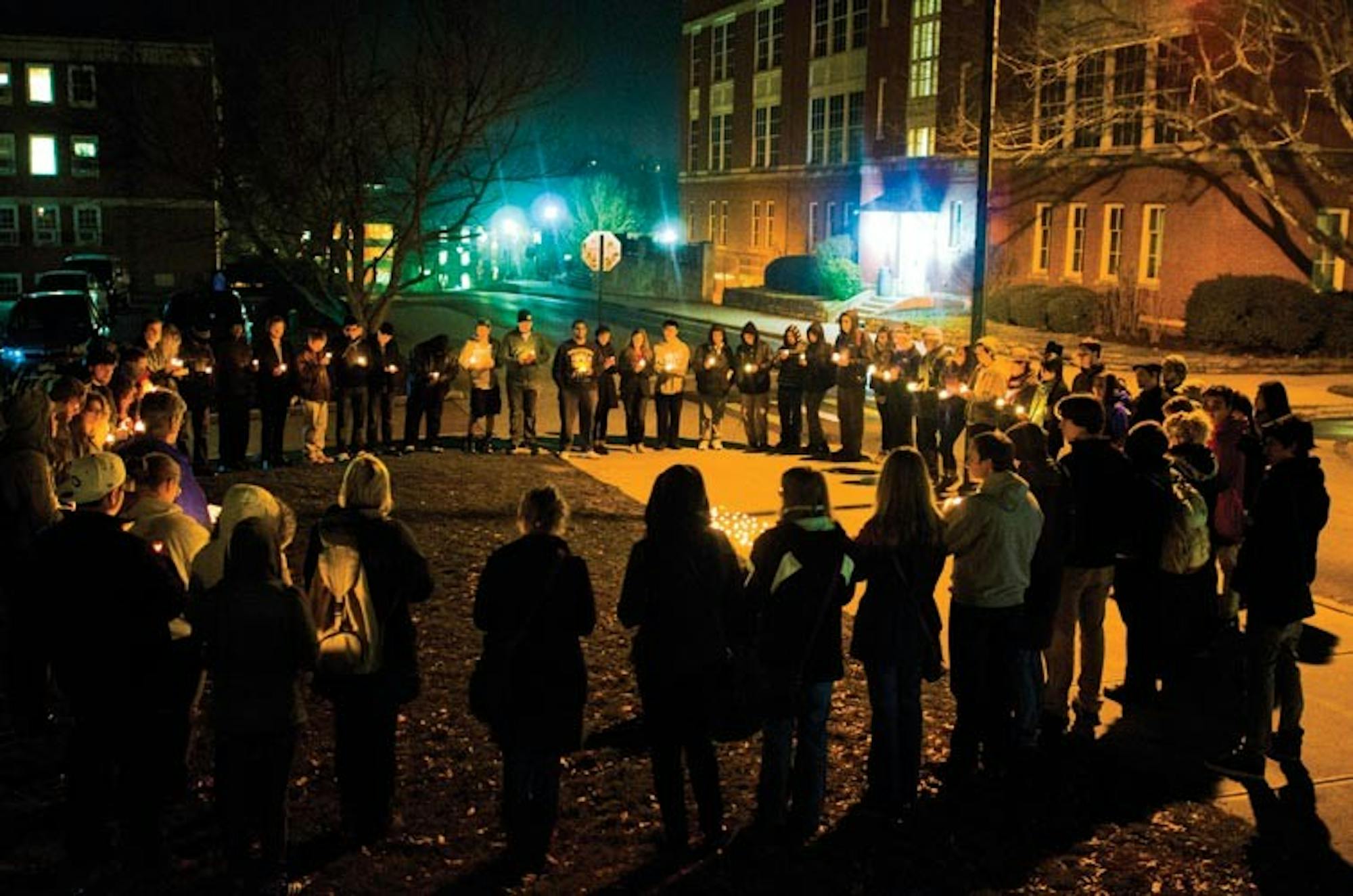
Ohio University’s campus came together for a memorial in honor of another university community about 6,000 miles overseas.
The University of Aleppo in Aleppo, Syria was bombed Tuesday when students were taking midterms. Aerial explosives were dropped, killing more than 80 people and leaving more than 150 injured, according to a U.S. Department of State news release written by department spokesperson Victoria Nuland
on Wednesday.
Organized by STAND Against Genocide, the Muslim Students Association and Project Nur, more than 50 students gathered in a circle on top of Morton Hill while lighting candles that spelled out the word “Syria” in remembrance of those impacted by the bombings as well as those who are in the midst of the Syrian Civil War.
“I thought it went amazing,” said Jack Spicer, co-president of STAND Against Genocide and a junior studying political science and pre-law. “I’m really proud of the Bobcat community.”
Students held candles while listening to different testimonies and offering words of hope, followed by a moment of silence.
The number of students who attended the vigil was encouraging, said Luke Kubacki, academic coordinator for STAND Against Genocide and a freshman studying political science.
“I think there’s at least a hunger for active awareness on this campus,” Kubacki said. “We need to start feeling it and push harder for justice.”
The Syrian Civil War began March 15, 2011 in retaliation against President Bashar Assad’s regime with an estimate of more than 60,000 casualties as a result, according to the United Nations.
Syria is still in the state of war.
Omar Almohealdeen, a 25-year-old native of Saudi Arabia, said the responses to the vigil were positive and commended.
“The ceremony portrayed the Bobcat community in a positive light,” he said. “I have a lot of friends in Syria. Hearing about the bombings hurt me. I am impressed by how the (OU) students were thinking of Syria.”
Even though the OU community is only one out of many university campuses across the country that organized a vigil, the message for the Syrian community is still important, said president of Project Nur Chelsea Flenar and a senior studying political science and Islamic studies.
“They’re not alone,” she said. “Through the conflict, they might feel disconnected, but we’re here for them and still thinking of them.”
hy135010@ohiou.edu


