

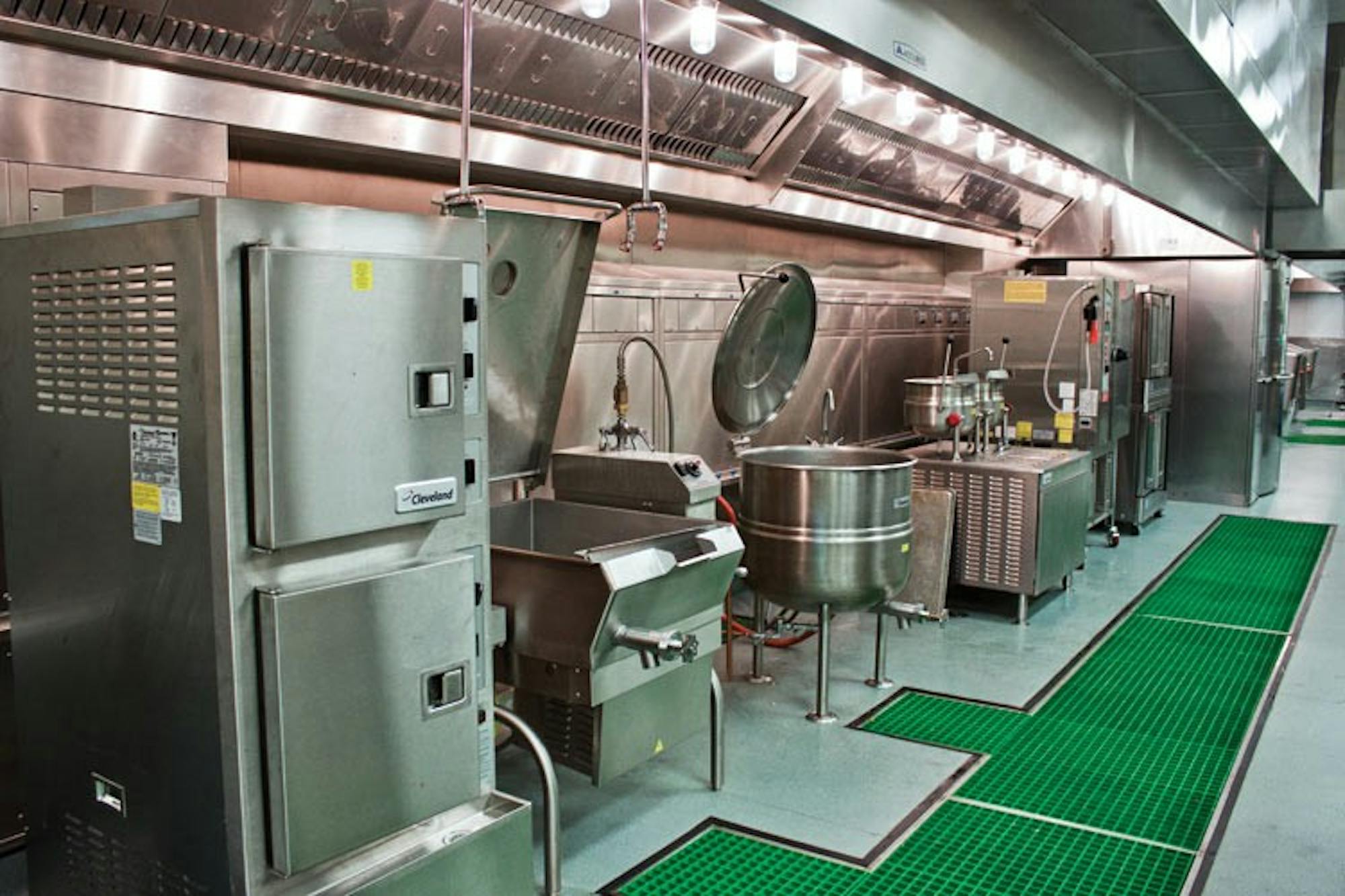
chen, the main production and preparation area for all dining hall food, is in the midst of major renovations.
The 48,800-square-foot facility, built in 1972, was 38 years old when the renovations began and is in the middle of a four-phase project, with phase two wrapping up shortly.
“The renovations allow us to focus on one main production point instead of on individual dining halls,” Director of Auxiliaries Brian Thompson said.
The project is part of the six-year capital planning strategy from Culinary Services, which department officials hope will improve the overall campus dining program.
Phase one, which focused on expanding and upgrading the main central kitchen, was completed in November 2011.
During the first phase, a “cook/chill” system was installed, allowing for easier and more efficient central production for meats, soups and sauces.
Thompson also said the first phase involved a considerable expansion of the main kitchen, adding 6,750 gross square feet of space.
The first phase cost about $7.7 million.
Culinary Services employees are working on completely new dining options for students, such as a low-sodium chicken finger option, said Mary Jane Jones, assistant director of Culinary Services, during a tour of the central kitchen.
“It takes a long time to develop a recipe that will actually work,” she said.
Jones also said the facility now has a professional butcher at all times who handles the meat. Since the completion of phase one, the main commissary has increased the use of beef strips by five times.
“We are always trying to invent new variety and increase customer experience,” said Dan Pittman, assistant director of Auxiliary Sales.
Jones said the facility goes through 120 to 140 cases of chicken as well as 2,000 pounds of cheese and deli meats per week.
Thompson said the main goal of the project is to maximize efficiency and streamline production in the central kitchen to emphasize “front-of-the-house” operations, allowing dining halls to prepare food in front of students, similarly to Chipotle.
Phase two is centered on the optimization of vegetable production, as well as the addition of a retail assembly space that will be used for prepping Grab N Go items, Thompson said.
Phase two will add about 7,500 square feet to the facility.
The new retail space allows for fresh, ready-to-use products that are easily available to students, Thompson said.
Phase three, scheduled to begin in the summer, will involve a full renovation of the bakery area, Thompson said.
The renovations will add between 5,000 and 5,500 square feet to the area but will focus on improving the bakery. In the facility’s 40-year history, the bakery has never been upgraded or expanded, and it is long overdue for a face-lift, Jones said.
Phase four, which remains unscheduled and is only in its initial design stage, will focus on the warehouse and dry goods area of the facility, Thompson said. He compared the final product to a Sam’s Club or Costco.
“We did a lot of site visits to peer institutions and places like Giant Eagle, Whole Foods, hospitals and casinos,” Thompson said.
The purpose of these visits was to benchmark how OU’s main commissary would shape up against some of the top kitchens in the country, Thompson said.
“You should start to see a consistent product now,” Jones
jr200009@ohiou.edu


