

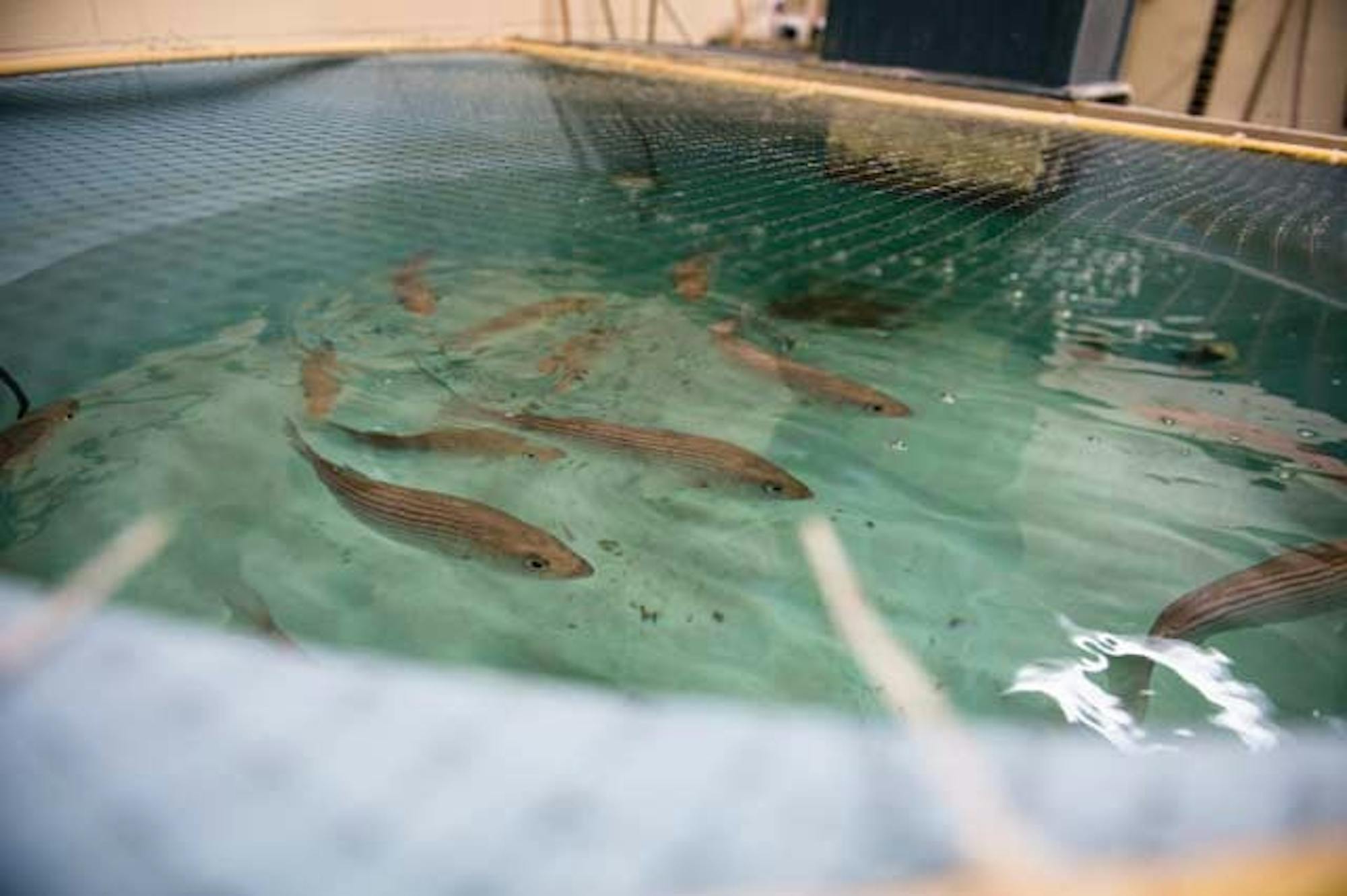
Ohio University takes precaution in ensuring the health and safety of its non-human residents on campus in an ethical and humane manner.
Housed in the Life Science Research Facility on West Green are animals used for testing and research, which includes 3,000 rodents, 100 reptiles and between 500 and 1,000 fish. Most of the animals are purchased through private vendors, said Scott Carpenter, director of the office of Laboratory Animal Resources.
“We have no random source,” Carpenter said. “Our main vendor is Harlan Labs, these animals are purpose-bred for research.”
The office was established and centralized in 1993, when OU took initiative to properly care for test subjects, Carpenter said.
“We follow a whole host of university and federal guidelines,” he added.
OU’s facilities undergo several inspections to determine if there is adequate husbandry of the animals during the time they are housed, every six months the Institutional Animal Care and Use Committee visits the facilities.
“We are also an accredited university for humane treatment of our lab animals,” Carpenter said.
The Association for Assessment and Accreditation of Laboratory Animal Care International is the organization that evaluates research facilities for proper treatment of animals. OU faces the re-accreditation process every three years and the next evaluation will be in 2015.
A lot of these animals are kept in different containment units that are at regulated temperatures that it would be comfortable in. Once there is a set up project, the animals would be placed into different rooms that a researcher calls for. Depending on the size of the experiment, the rooms vary from 150-500 square feet.
Researchers who want to house their experiments inside the facilities are charged a daily rate for the care of their projects. Carpenter said that the LAR received $258,354.25 from individual researchers grants, and department funding for the 2012 fiscal year. The Vice President of Research and Creative Activity Joe Shields also contributed an additional $270,157.26, which covered various aspects of running the department, including a staff of six people, and four students, as well as supplies and maintenance costs.
In the state of Ohio, there have been some lawsuits filed against universities with charges of inhumane lab animal treatment.
Ohio State University was sued for the deaths of several chimpanzees in 2006, according to a lawsuit filed by Dr. Sarah Boysen, who used the animals for cognitive research.
Another regulation that the LAR follows is the Animal Welfare Act of 1966, which observes treatment of animals in research and exhibition. It is currently the only federal law that outlines care of research animals.
Carpenter said that in the 15 years that he has been employed at OU, he has not encountered many extreme acts of opposition against the usage of research animals for medical studies.
“We received only one letter from PETA during their statewide campaign a couple years ago,” he said. “Otherwise, we really haven’t gotten any negative feedback.”
Lisa Crockett, an associate professor in the Department of Biological Sciences, said that she has used the facilities for her studies on fish and their behavior since 1995. Without the use of animals for research, there would be no progress, Crockett said.
“It is necessary when non-living models are inadequate,” she added.
However, Rebecca Iacobone, a senior studying environmental geography, said she was conflicted with the use of animals in experiments.
“I don’t think that animals are just a disposable resource for human use — they think and feel and deserve our respect and appreciation,” Iacobone said.
“However, until those afflicted with yet uncured conditions are all willing to be test subjects for underdeveloped medicines, yes, I’d say it’s necessary.”
hy135010@ohiou.edu


