

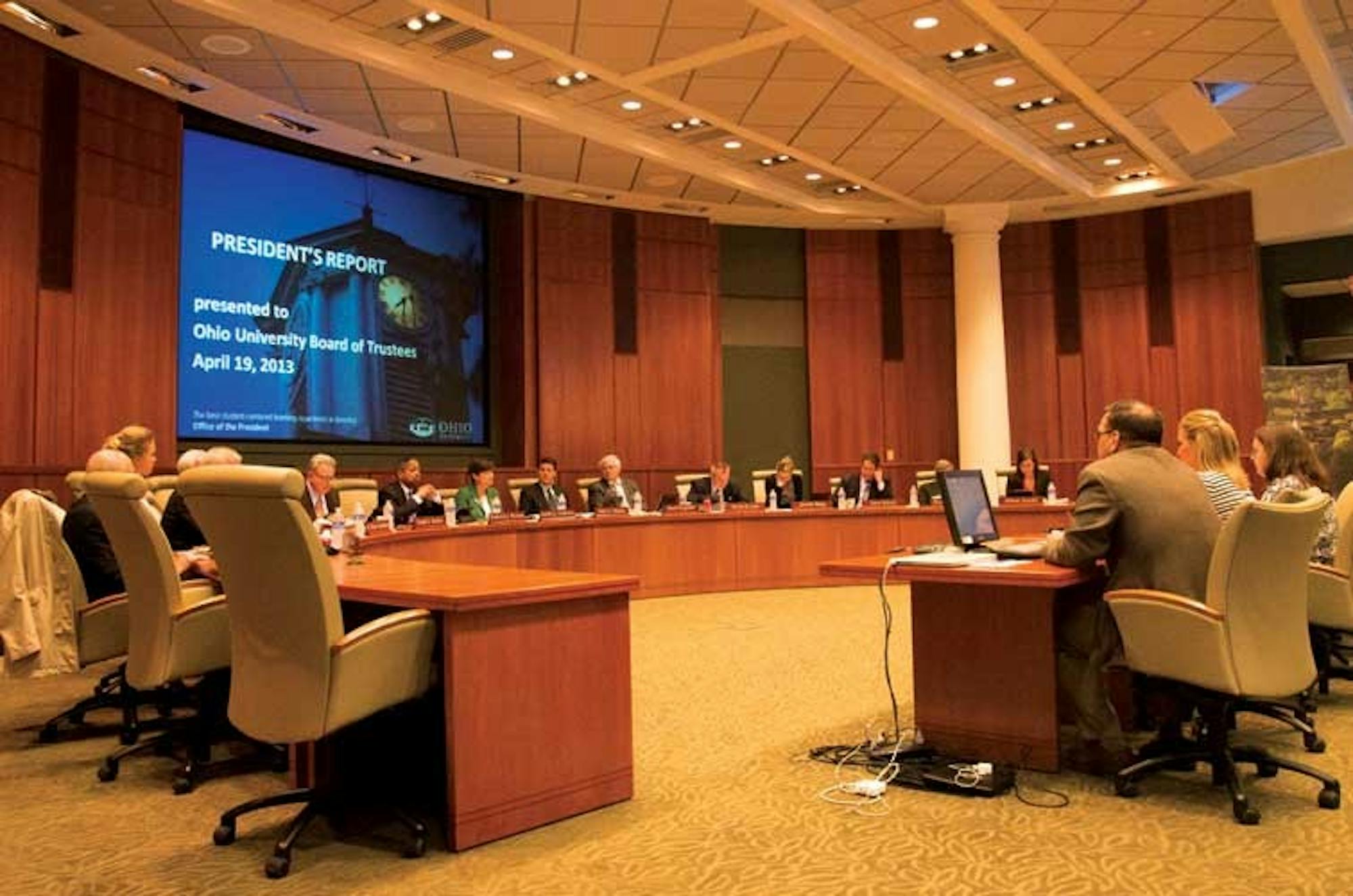
Her wooden gavel banged on the desk for a third time and she shouted: “I am suspending this meeting.”
Trustee Sandra Anderson suspended the Board of Trustees meeting after a 1.6 percent tuition increase was passed. Four student protesters were arrested for disturbing a lawful meeting, but tuition wasn’t the only increase the board approved.
In addition to resolutions that will increase Ohio University’s tuition, some will increase the university’s debt and others encouraged further discussion of the guaranteed tuition model.
There will be no increase in graduate tuition or the nonresident surcharge to tuition.
Undergraduate in-state tuition per year, currently set at $10,216, will increase to $10,380 for the 2013-2014 academic year.
“We believe that we have been sensitive to the concerns of students,” OU President Roderick McDavis said.
Tuition increases began in the 2010-2011 academic year, according to the OU Factbook.
“They see us as nothing more than a revenue stream and we are not,” said Megan Marzec, a protestor and a sophomore studying studio art.
Faculty Senate executives sent a letter of support for the 1.6 percent tuition increase in order to maintain OU’s academic quality, said Faculty Senate Chair Elizabeth Sayrs.
“For us, the issue was if tuition didn’t go up, there would be cuts to academics, and if we don’t get the best faculty now, in 10 years we won’t be as good of a university,” Sayrs said.
Additional resolutions increased residence hall room-and-board rates as well as tuition for Heritage College of Osteopathic Medicine and OU regional campuses.
For students who live on campus, Residential Housing costs will increase by 3.5 percent and meal plan rates will increase by 0.5 percent.
There will be a 5 percent increase in the instructional fee and non-resident surcharge at the Heritage College of Osteopathic Medicine — totaling $14,538 and $6,505 per semester, respectively, for the 2013-2014 school year.
Lower division students with 60 or fewer hours on regional campuses will have tuition increase to $4,712 a year for students at OU Eastern, Southern and Proctorville campuses or $4,908 for all other campuses.
In-state upper division students on any OU regional campus will see tuition increase to $4,996.
As a compromise between OU’s financial needs and affordability for students, the board will continue to pursue the guaranteed tuition model.
Stephen Golding, vice president of Finance and Administration, projected a possible model for OU if it were to enact the guaranteed tuition model, but these proposed numbers are likely to change, he said.
Any cohort increase — which would be the increase for each entering class — of less than 9 percent would make tuition equate to less than the incremental tuition with the historic average inflation of 3.5 percent, Golding said.
OU is currently considering tuition increases of either 5.9, 7.4 or 9 percent between the separate cohorts.
In order to incentivize the guaranteed tuition model, Benoit and the scholarship task force are assembling a donation drive goal of about $25 million with the purpose of matching those funds 2 to 1 in order to create $75 million in new scholarships.
OU will include tuition, room-and-board and course fees into the guaranteed package, said Pam Benoit, executive vice president and provost.
The model is more likely to be ready for fall 2015, Benoit said.
“If the legislature approves this and our board motivates us to move forward, we are going to work really hard,” McDavis said.
At the next board meeting June 21, McDavis and Benoit plan to present a more detailed plan to implement the tuition guarantee.
dk123111@ohiou.edu


