When the state hands over money for Ohio University’s construction projects, legislation requires some of those funds be spent on more than just nuts and bolts.
If a construction project receives more than $4 million from the state, 1 percent of those funds must be set aside for a corresponding art piece, as mandated by Percent for Art legislation — Ohio Revised Code 3379.10.
The legislation, in effect, pulls some state dollars allocated to construction projects.
But Ohio’s small amount of state capital appropriations in recent years has prevented similar art components in OU’s current construction projects.
The law went into effect July 1, 1990. Since then, 10 art pieces on OU’s campuses were funded by the Percent for Art program, according to the Ohio Arts Council website.
In the U.S., 23 states have similar laws currently in place, including Minnesota, Nebraska and Alaska, but none of Ohio’s surrounding states.
All 13 public universities in Ohio have acquired pieces through the Percent for Art program.
The OU committee that oversees these funds hasn’t met recently, said Edward Pauley, OU’s director of the Kennedy Museum of Art and OU Percent for Art committee member.
“Funding projects with state appropriations stopped years ago because the money went a bit further (then),” said Harry Wyatt, associate vice president for facilities. “State appropriations for the last two years and most likely for the next two years won’t reach that $4 million threshold.”
State appropriations are determined biennially. For the 2013-14 school year, OU received $18,620,500 in total state appropriations for capital projects. That’s a 12 percent decrease compared to the state funds OU received in the 2005-06 school year — $21,121,350 for construction.
Private fundraising, selling bonds, debt issuances and gifts fund most of the university’s construction projects.
The most recent capital project to receive state funding exceeding $4 million — therefore requiring the university to spend state money on art — was the approximately $35 million Academic and Research Center on West Green in 2010.
The project received $9 million in state capital appropriations. The corresponding art piece, called “Waveform” by Alyson Shotz, cost $85,500. The piece is made of aluminum tubes and laminated with acrylic to replicate a helix.
OU has not paid for the purchase, development or installment of these projects, but it does have to pay for upkeep.
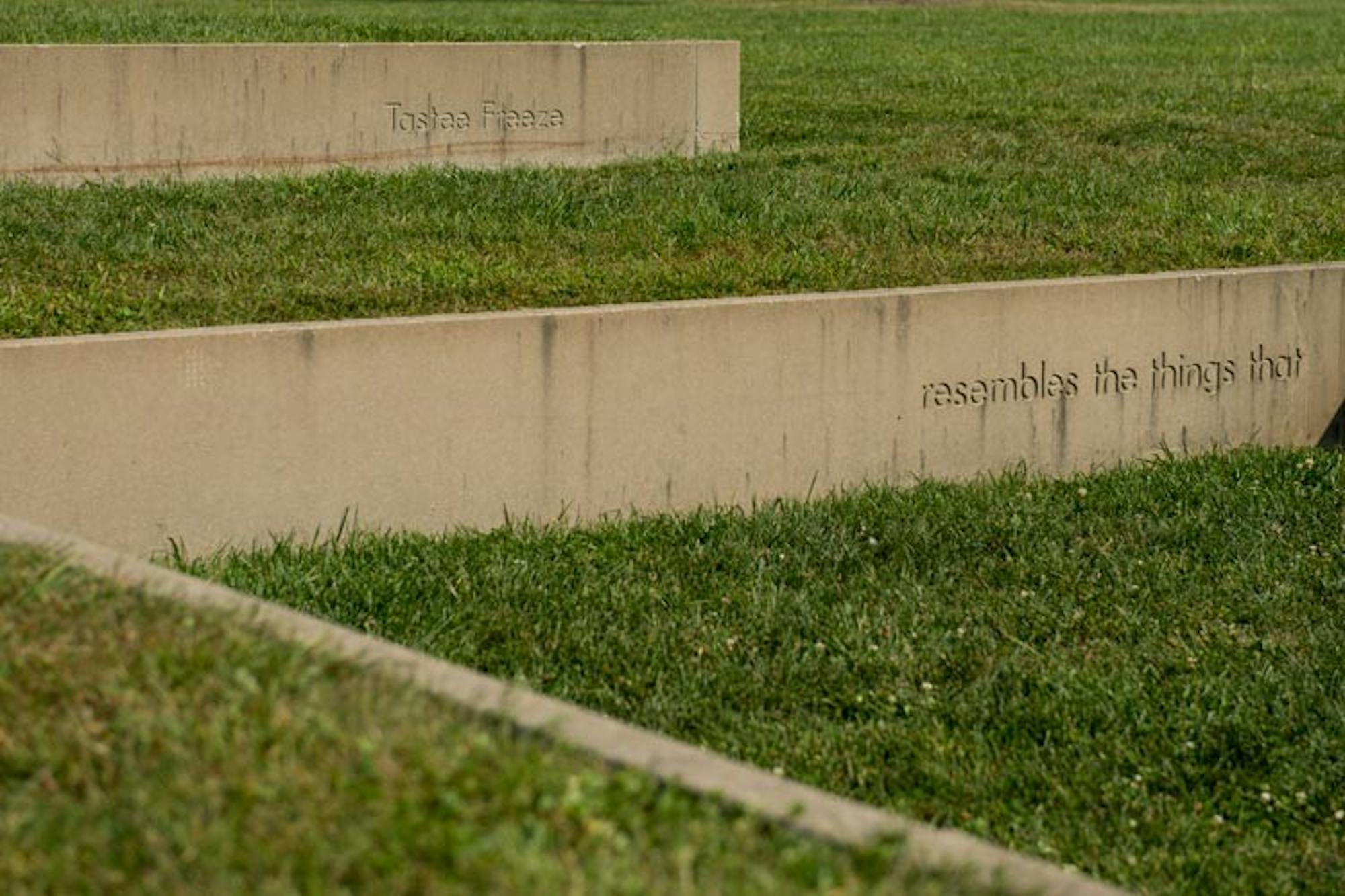
Most pieces are located inside and don’t require updates, but those found outside are weather-resistant. The Percent for Art piece in Gordy Hall on College Green, however, has electrical features that need updating.
The piece is a marquis that scrolls the artist’s sayings in several languages, but it hasn’t been lit in some time, Wyatt said.
Because the university is using state appropriations for more pressing, smaller-scale projects — including exterior painting and outside stair replacements — fewer of its projects are hitting that $4 million mark, meaning fewer are requiring a corresponding art piece.
“It’s happening a lot. A lot of colleges ask for funds and the state is operating under a tight budget,” said Ken Emerick, individual artist grants and services director and Percent for Art program director. “State budget is pretty tight right now; maintenance takes priority.”
Every two years OU sends a proposed capital improvement plan to the state, which determines the amount in state appropriations for construction as well as projects’ qualifications for Percent for Art funding.
From the 1 percent in state appropriations’ funding for Percent for Art pieces, 93 percent is for the artist’s commission and art projects’ costs. The remaining 7 percent is used for administrative and artist selection fees.
The Ohio Arts Council serves as a liaison between OU and the individual artists that work on its pieces and oversees the contracts, said Kathy Signorino, individual artist grants and services program coordinator and Percent for Art program coordinator.
Percent for Art funding cannot be used for specific purposes, including reproducing original works of art, maps or signs or university decorations designed by the building architect.
But though fewer construction projects are requiring state-mandated art, Wyatt said the university is finding ways to incorporate art on a budget.
“We’re looking at rotating art from Kennedy Museum,” he said. “We’re looking at ways to incorporate what we have and what we own without necessarily buying new.”
hy135010@ohiou.edu
@HannahMYang