

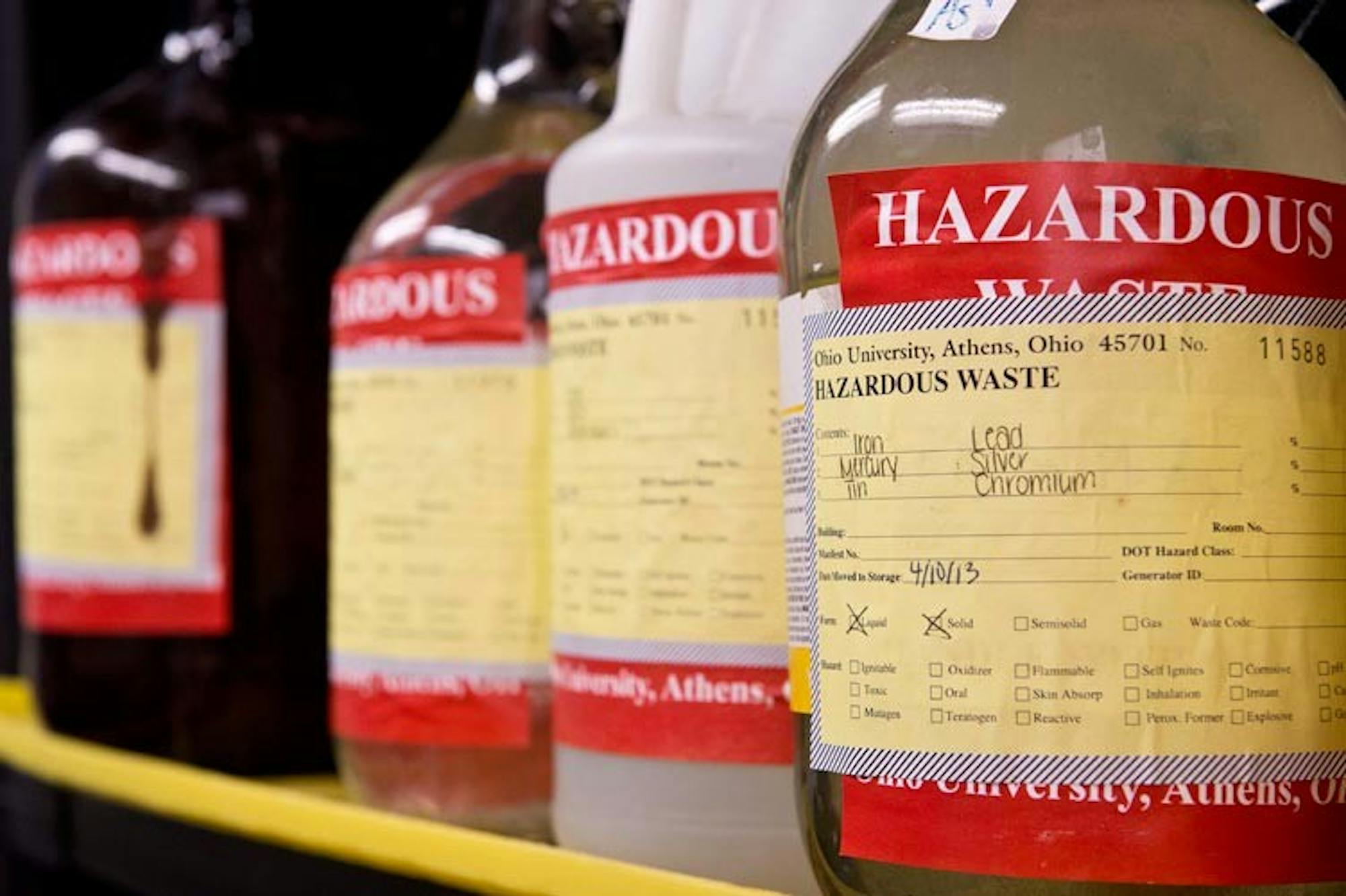
When a chemistry class in Clippinger Laboratories makes potassium dichromate, pouring the corrosive and carcinogenic substance down the sink would be an unfortunate end for the fish — and some humans — of Athens.
But somebody has to get rid of it.
Ohio University has several methods of disposing — and, depending on the material, sometimes recycling — hazardous materials produced in labs and other campus facilities.
Cliff Hamilton, an environmental engineer for OU’s Environmental Health and Safety, said he primarily takes care of removing materials classified as hazardous by the U.S. Environmental Protection Agency, such as chemical waste from Clippinger, Stocker Center or the Academic and Research Center.
Although Hamilton removes the hazardous material from OU’s facilities, the university pays Chemical Analytics Inc., a hazardous material disposal company serving research centers and universities, to haul it off.
Last year, the bill was $22,000, Hamilton said.
OU’s Environmental Health and Safety calls Chemical Analytics about every nine months to pick up hazardous waste, which in the meantime is stored in two storage units at The Ridges, Hamilton said.
Clippinger, the facility that produces the most chemical waste on campus, contributed fifteen 55-gallon drums and slightly more than 70 four-liter bottles of waste to last year’s disposal bill.
Katie Black, a sophomore studying biological sciences, said half the time she works with chemicals in either a lab class or her research position over the summer, she would have to put them in a chemical disposal container under the chemical hood.
“When you’re working with so many different substances and solutions, it can get kind of confusing,” Black said.
The cost of removing the waste depends on the amount and type of material.
OU’s Lausche Heating Plant, which provides heating primarily through natural gas to the university, doesn’t produce a lot of waste because it uses or repurposes most of the materials it takes in, Hamilton said.
“Just because (materials) are hazardous waste doesn’t mean they’re not being recycled,” Hamilton said.
Although collections from biohazard bags are incinerated, Hamilton said Chemical Analytics is able to recycle a large portion of OU’s chemical waste by mixing it in fuel or selling it to cement kilns or asphalt factories.
If a lab instructor needs to remove waste, he or she can submit a form to Environmental Health and Safety, and Hamilton and his PACE student assistant will decide how to dispose of it.
If the description left by the lab instructor is vague or Hamilton is unsure of the concentration, he will test the substance to determine what to do with it.
OU Facilities Management also frequently requires removal of hazardous materials, such as old cleaning products or leftover paint. Those are hauled off by Chemical Analytics.
When the carcinogen asbestos is found in OU’s buildings, however, each construction project’s contractors remove it, said Harry Wyatt, associate vice president for Facilities.
Asbestos is typically found in tiles inside buildings and isn’t dangerous until the tiles become friable, or crumbly, Wyatt noted.
“However, if we are doing a rehabilitation of the building, we are proactive and we remove that tile,” Wyatt said.
dk123111@ohiou.edu
@DanielleRose84


