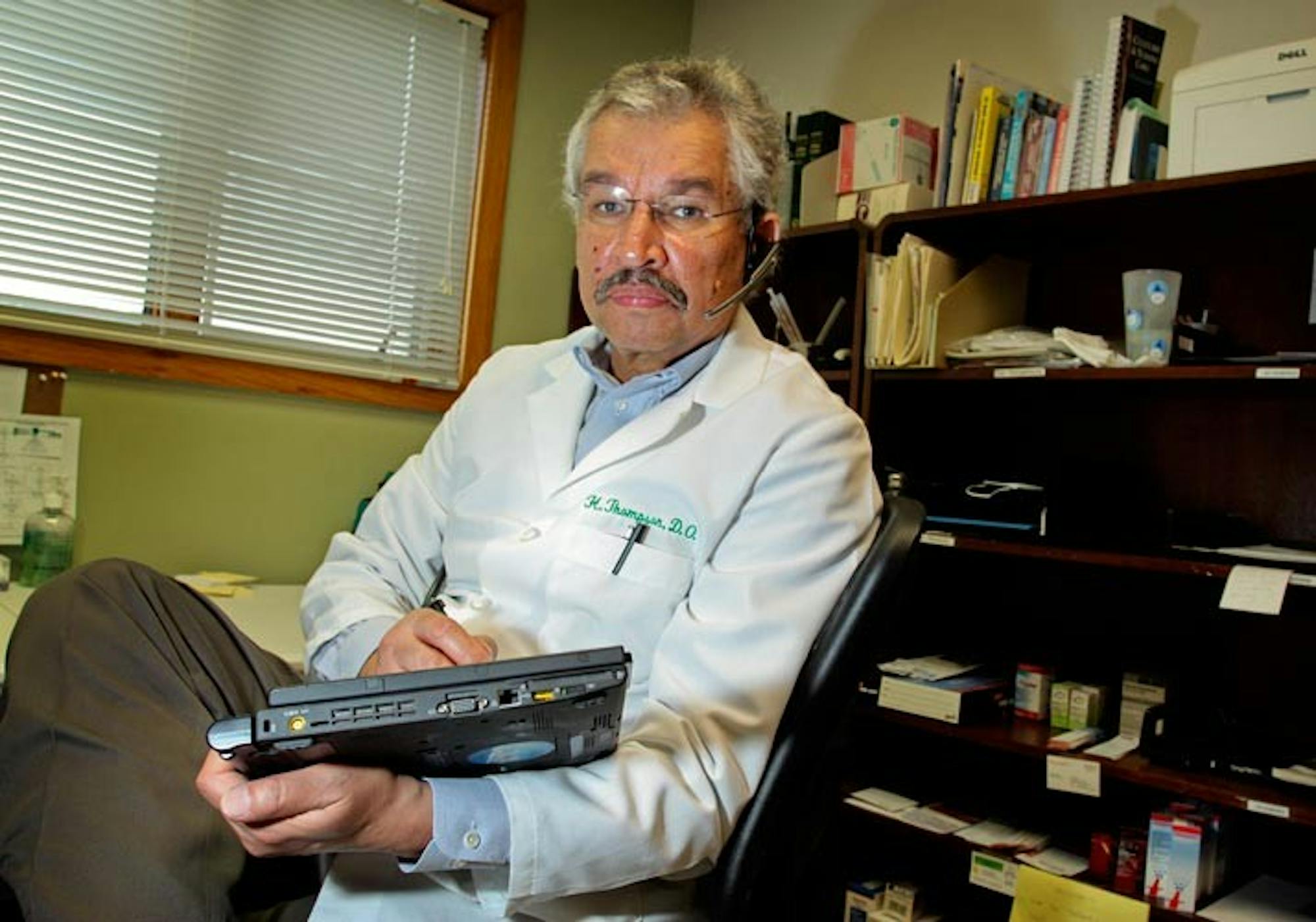
The responsibility to determine what to write on an individual’s death certificate rests with the coroner, and in Athens County, an Ohio University faculty member holds the pen.
County Coroner Harold Thompson, who studied medicine at the Chicago College of Osteopathic Medicine, now faces an ironic balancing act between his two positions: teaching students how to bring the injured or sick back to life while being duty-bound as a county coroner to establish how people died.
“The challenges are remembering you are a servant of the people,” Thompson said, “and that I went into medicine to help people in life, and, as the coroner, in death.”
Despite holding an elected office, Thompson’s center of operations is not found in a county building. Instead, the Chicago native’s office is in Grosvenor Hall on West Green.
He doesn’t have the certification to perform an autopsy so he doesn’t have or need a medical facility to do his work.
Cadavers from Athens County are sent to the Montgomery County Coroner’s Office for autopsies, so Thompson can essentially work anywhere. His OU office serves as somewhat of a home base.
County officials argue that Thompson, as an assistant professor of emergency medicine, saves the county money by working on campus.
A county coroner in Ohio need not be able to perform autopsies, which are typically performed by forensic pathologists or a medical examiner. He or she just needs to be an Ohio resident who is a physician and in good standing with the medical board, according to the Ohio Revised Code. Coroners don’t have term limits.
As coroner, Thompson is called to death scenes to determine how an individual died. Because of his teaching schedule, he occasionally can’t make it out to scenes, and thus he has two investigators who can go out and report back to him.
Thompson also receives reports from the forensic pathologists who perform autopsies and ultimately determines the cause of death based on those reports.
Both county and university officials say Thompson’s academic and county duties remain distinct and separate. He’s serving his second term as the coroner and was re-elected last year.
Thompson made about $58,000 in 2012 as coroner, supported by county funds, according to county records. Separately, the university pays his $129,890 salary as an assistant professor of emergency medicine at OU’s Heritage College of Osteopathic Medicine.
A county coroner’s salary is partly population-based and also determined by the number of autopsies. The Athens population is about 6,400 residents, and Thompson receives about 80 to 85 cases annually, which, because of budget matters, he can decide to either refuse or accept.
“Unfortunately, there’s stress on county budgets right now,” said David Corey, executive director of the Ohio State Coroners Association. “Coroners really pick and choose a lot of the cases they get.”
Estimated costs of autopsies are $1,200 and transportation more than $300, all of which are covered under the coroner’s budget, Athens County Commissioner Charlie Adkins said.
The coroner’s budget was about $132,000 last year.
Corey said coroners sharing facilities or forensic pathologists are a common trend statewide and nationally.
Six counties in Ohio have facilities considered regional autopsy centers, where cadavers can be sent for examination: Hamilton, Franklin, Cuyahoga, Summit, Montgomery and Lucas. A few smaller counties have their coroners certified to perform autopsies or have big enough budgets for forensic pathologists.
When an autopsy is performed in Montgomery County, it sometimes takes about three months for an autopsy report to come back to Thompson.
“That does not mean we cannot serve the people well,” Thompson said. “We’re still well served in the location that we’re in.”
Corey said a coroner can’t put his or her own county’s deceased over others that are sent from surrounding areas. All are placed in one queue, a process Corey said generally doesn’t increase wait time for results to come back. Once Thompson does get what he needs, he can determine a cause of death.
Adkins said it wouldn’t be “cost effective” for Athens County to have its own facility.
“It would be quite costly,” he said. “I don’t see that happening during my term.”
Kent Harshbarger, Montgomery County coroner, could not be reached for comment by press time.
For now, Thompson said he’s satisfied with the way the coroner’s office works in Athens. He’ll continue to serve the county and his students from OU’s campus, he said, balancing two jobs he finds equally important.
“Sometimes I’d be teaching class and I’d get a call on a case,” Thompson said. “It’s hard to go out on a case. … Of course, death doesn’t follow a timeline.”
hy135010@ohiou.edu
@HannahMYang