

This originally appeared in print under the headline "Landlines serve as a reminder of the past"
Sitting in a classroom with no laptop, cell phone or tablet but only a notebook full of paper and a pen or pencil may seem old fashioned, but it wasn’t long ago when this was the reality for most Ohio University students.
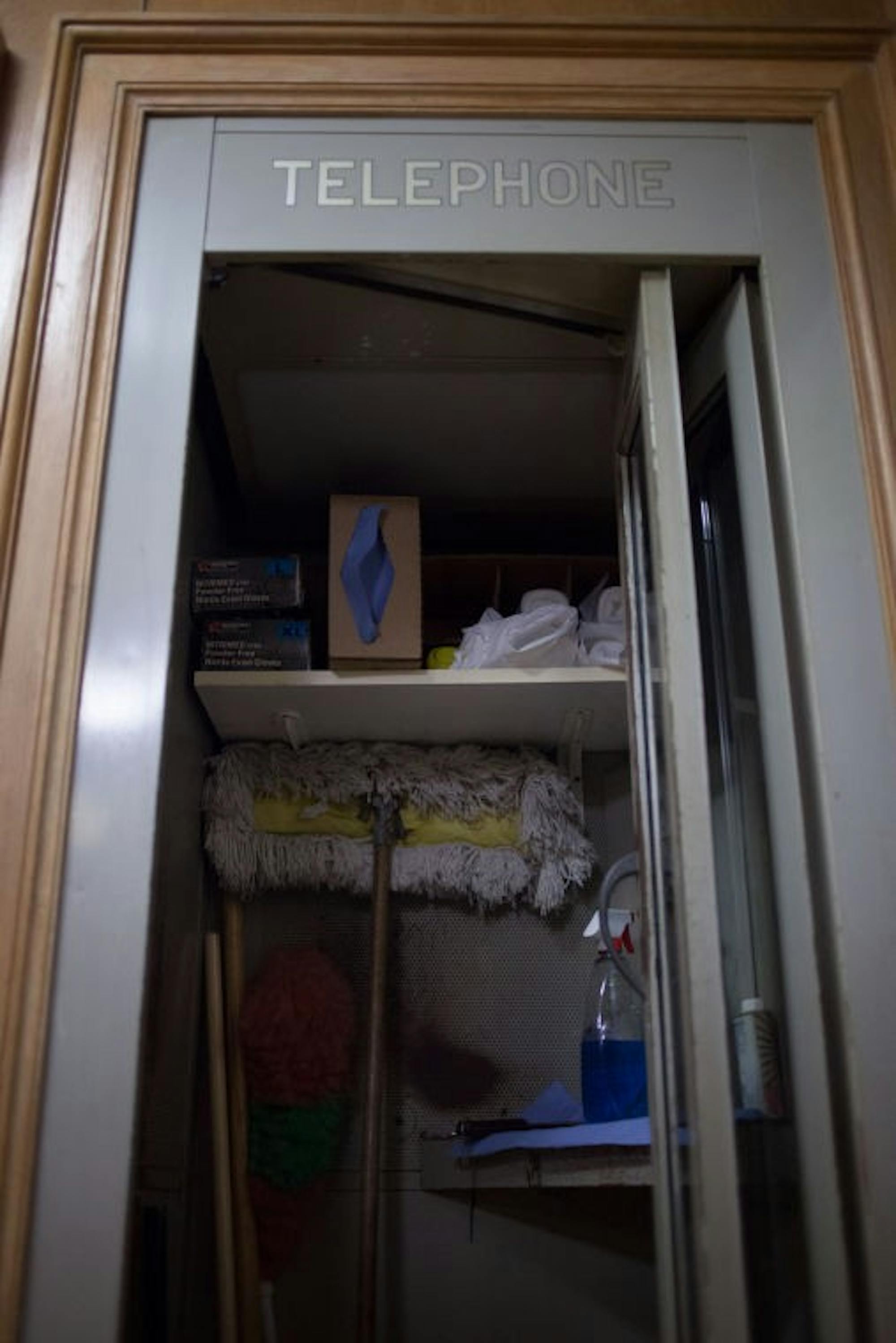
Students may take technology for granted nowadays, but remnants of old technology remain, as outdated landlines still occupy residence hall rooms.
Kevin Arsenijevic, a junior studying theater production design and technology, is one of those students with a landline who mainly uses it to call his friends down the hall.
“I have it for the novelty of having a landline in modern society,” Arsenijevic said, although he still owns a cell phone that he uses regularly.
However, lining the construction site of the new South Green dorms is a reminder of how far technology has advanced since OU student housing was first built. A dated picture of an OU student making a landline call from her residence hall is plastered around the construction site.
In fact, the new residence halls on South Green currently under construction will not have landlines in student rooms because of the popularity of cell phones, said Joshua Bodnar, assistant director for communication and technical operations in residential housing.
These old items that used to be essential are little more than interesting pieces of history displayed on a shelf or desk in a residence hall room. There was a time, though, when people were not connected 24/7 like they are today.
Back when Joanne Prisley, an OU alumna who graduated in 1953, attended school, she said they had difficulties dealing with cumbersome landline phones in the residence halls.
“If you had a problem you might call home,” Prisley said. “The idea now of calling people all the time boggles my mind.”
Laura Burns, senior Library associate, and Doug McCabe, curator of manuscripts, said when they attended school back in the ’60s and ’70s only in cases of extreme emergencies would students even call their families. When the bill came to the residence hall, roommates would fight over who made what calls and how the bill should be split, they said.
High phone bills made writing letters more economical, even among neighboring residence halls.
The Knisely-Varner Letter Collection is an example of an on-campus romance from the 1930s, in which Orson Knisely and Bernice Varner Knisely exchanged love letters during their years at OU because women had strict curfews to abide by.
The couple eventually married and their daughter donated the letters, preserving their romance in the Mahn Center for Archives and Special Collections.
“The letters are not only an account of their relationship, but they also are a good representation of student life at OU during that time,” said William Kimok, University archivist and records manager at Alden Library.
@TiffanyTouville
tt315212@ohiou.edu


