

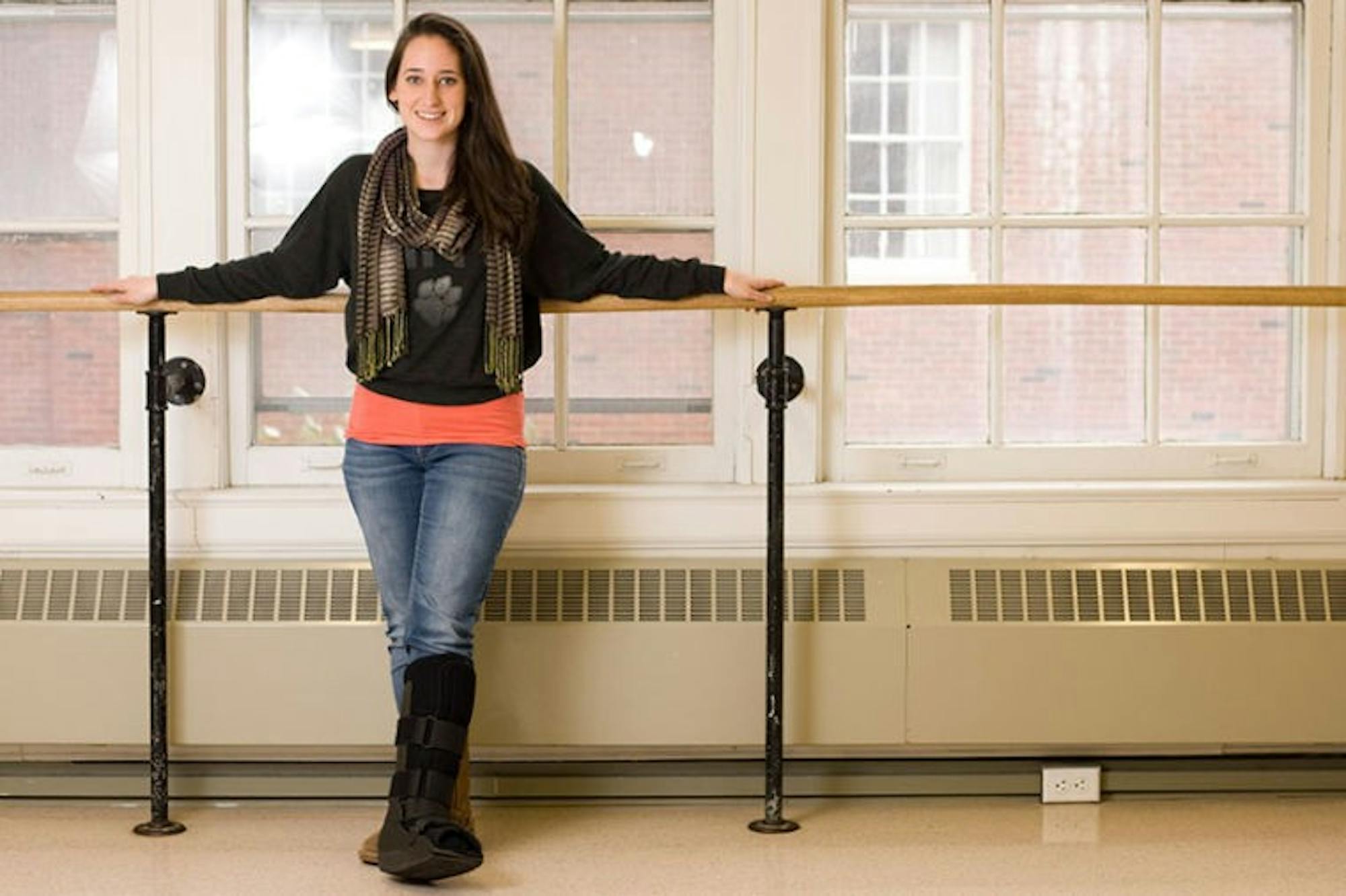
Dancers’ feet may look graceful and elegant, but what’s underneath the shoes can be shocking. Most sport injuries are thought to happen during contact sports. Unfortunately, most dancers know that this is not true.
“In both of my feet I have Sesamoiditis,” said Rebecca Sebo, a junior studying dance. “(It’s) when you have two floating bones underneath the ball of your big toe. Both of mine are cracked, and I can’t get that fixed or I wouldn’t be able to dance. I also have Morton’s Neuroma, which is a pinched nerve between my metatarsals and that was caused from all of the dancing.”
During Sebo’s 12 years of dance, she has had multiple injuries caused from the activity, and she is currently in a boot from a stress fracture on her right tibia.
With experience from all of the injuries Sebo has had, she’s learned to take precautions.
“If I feel something achy or sore I don’t wait anymore,” Sebo said. “I go check it out, I talk to the SHAPe Clinic, I wrap my feet, or if my ankle is sore I’ll wear my brace for that day.”
The SHAPe clinic is for performing artists such as dancers, music students, the Marching 110, theatre performers and theatre production majors.
“We saw 180 patients last semester,” said Dr. Jeff Russell, the director and creator of the SHAPe clinic and an athletic trainer. “With the dancers we get some overuse injuries and some traumatic injuries. It’s been in my heart that we need to do something better for performers, and that’s why I started in this business and took this opportunity here.”
Although dancers can have strain on many parts of their bodies, some of the most common injuries are to their feet.
“Typically the most common injury will be in their foot and ankle,” Russell said.
“We know by doing research that as much as 60 percent of dance injuries are in the foot and ankle. Within the foot and ankle we’re seeing some sprains — that’s the most common traumatic injury — but we also have a lot of tendon injuries like Achilles tendon and then FHL, which is short for Flexor Hallucis Longus.
FHL is critically involved in the dancer’s movement because if it is not taken care of properly, your dance career is over.”
Precautions to avoid these life-changing injuries can also be taught within the dance school. Marina Walchli, a professor of dance, teaches knowledge of the musculoskeletal system, its organization and how it functions in dance movement in her dance classes.
“The courses give dancers background knowledge to help them train and develop injury-free careers,” Walchli said in an email statement. “The courses provide knowledge that makes dancers more informed health care consumers and helps them understand how to train for long healthy careers in dance.”
Dancers have been told about these injuries and the precautions necessary to avoid them, and some have experienced the injuries themselves. But it’s not enough to make many of them give up dancing.
“It’s what makes me happy,” Sebo said. “It’s my major and it’s what I want to be my life. Every injury I get puts me out a little bit, but I learn something from it and I try to stay healthy and in shape as much as I can; but it’s not going to keep me from dancing.”
@annachristine38
ag836912@ohiou.edu


