

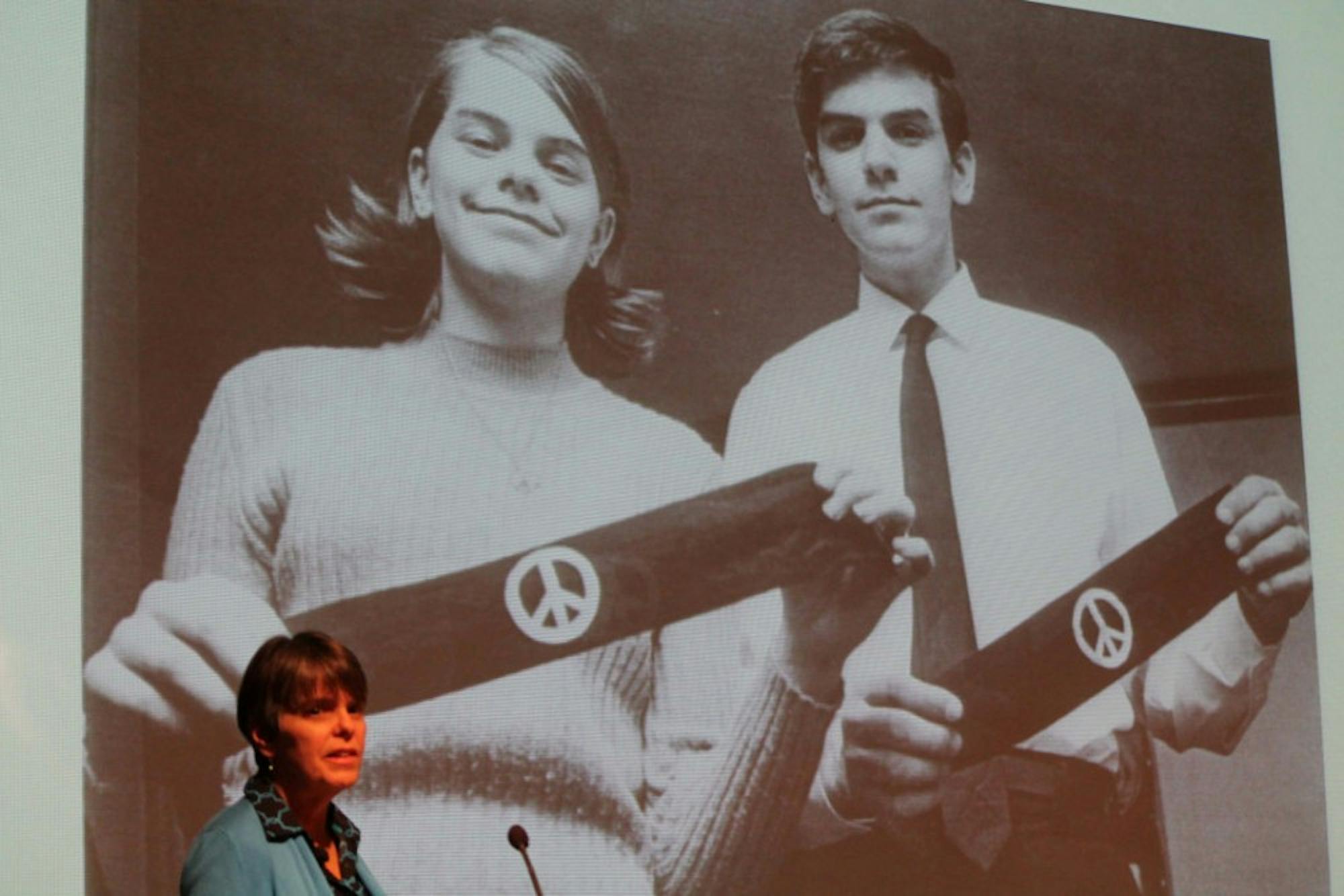
Though she was one of the students behind the landmark Supreme Court case Tinker v. Des Moines, Mary Beth Tinker said it was years later when she realized the significance of her black armbands.
Though she was one of the students behind the landmark Supreme Court case Tinker v. Des Moines, Mary Beth Tinker said it was years later when she realized the significance of her black armbands.
Tinker stopped at Ohio University while on her “Tinker Tour USA,” which she uses to advocate for youth rights. She spoke at Baker University Center Theatre on Thursday night to a group of approximately 60 people.
In 1965, Tinker and some of her friends wore black armbands in school to protest the Vietnam War. The school then suspended her, which led to a lawsuit questioning the legality of the decision.
The controversy eventually led to a 7-2 Supreme Court decision, which some have seen as an advancement of free speech in schools.
She credited her upbringing in Iowa and her parents’ religion and activism as influences on her life.
“People of faith all through history have been speaking up, standing up and putting their faith into action,” Tinker said. “We started thinking that maybe speaking out and standing up is a good idea.”
Tinker also discussed the history of youth activism from slavery to the Civil Rights movement. She told stories of children who took action, including Sojourner Truth, Frederick Douglass and Claudette Colvin.
“We need young people to notice injustice and to notice what’s missing in our democracy,” Tinker said.
She also said that racial injustice and the horrific violence in Vietnam caused Tinker and her peers to consider standing up for peace.
“Our position was very unpopular,” she said. “That’s why we need free speech. That’s why we need a first amendment.”
Tinker said she later became a nurse and worked with children. She said she was fascinated with how young people’s brains help cause them to take a stand.
“Kids are made to change our world and push things forward,” she said. “It’s in the dopamine in their brains, so they take risks. Kids will be the next great leap for democracy.”
After the speech, Tinker answered questions and talked to the audience about current free speech issues.
Isaac Smith, fifth year senior studying political science, asked Tinker about how student speech has changed through the years.
“There has been a definite trend to take away the rights of students since the Tinker case,” Tinker said. “Now student rights and teacher rights are often paired together.”
Dwight Woodward, instructor at the E.W. Scripps School of Journalism, asked Tinker if other activist movements have been inspired to use black armbands as a symbol.
“Sometimes I go see high school kids and they’re wearing all different colored armbands for different subjects,” Tinker answered. “A girl in Ukraine also wore a black armband in the Olympics, and she was told by the Olympic Committee that she could not wear the armband.”
@alxmeyer
am095013@ohio.edu


