

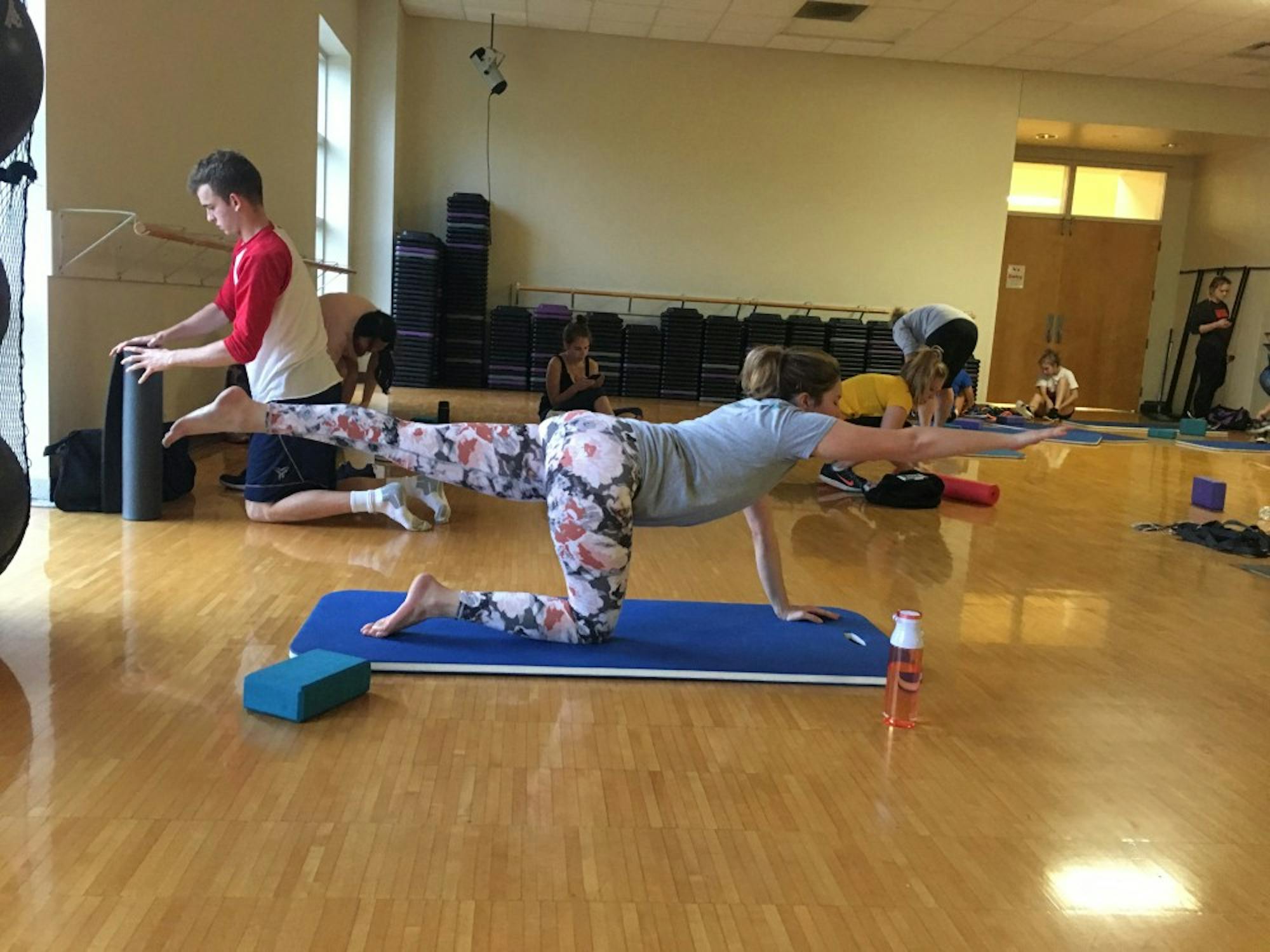
Popular yoga classes taught in uptown studios and on campus vastly differ from yoga practiced by its age-old founders.
In 2012, 9.5 percent of U.S. adults practiced yoga, which was an increase from the 6.1 percent that practiced it in 2007, according to a study done by the National Center for Complementary and Integrative Health. Despite the increase in popularity of yoga in the U.S., modern yoga barely resembles its ancient origins.
The type of yoga practiced today is quite different from the yoga practiced by ancient people in Asian countries. What most people today picture yoga as is actually “postural yoga,” which is a recent form of exercise yoga that was introduced to the Western World around the 1960’s, Brian Collins, a classics and world religions professor at Ohio University, said.
Postural yoga focuses more on assuming certain poses, some of the more famous being Lotus position, Downward-Facing Dog pose and Tree pose. Whereas many types of ancient yoga were rooted in meditation, Collins said.
“What we call today yoga takes elements from a lot of different things, and one of them is this ancient Indian tradition that has to do with philosophy,” Collins, who is teaching a class on yoga culture next spring, said. “There is a spiritual and a material universe that one can synthesize through different practices.”
He said the basic concept of ancient yoga was to have total control over oneself.
“Mostly (yoga is) about moral restraint,” Collins said. “It’s about controlling the senses, what we would more call a meditative practice.”
Because yoga has cultural roots in Indian culture, some may consider its adoption by the Western world to be appropriation.
In 2015, a yoga class at the University of Ottawa was canceled due to worry over whether the practice was being culturally disrespectful, according to an Ottawa Sun article.
Collins said changing yoga so drastically from its original form is not necessarily disrespectful to the culture. He added that the Indian government is encouraging and even facilitating the spread of yoga to the Western world.
According to a Forbes article, Narendra Modi, the prime minister of India, spoke about the positive benefits of yoga and its ability to solve the world’s problems. India’s General Assembly implemented a International Day of Yoga in 2014 to encourage everyone to practice it.
Leslie Corbitt, a senior studying education, teaches a yoga class at Ping. She said even though some may see the adoption of yoga as cultural appropriation, she doesn’t.
“I did learn about where it came from and the different breathing and the different chakras,” she says. “I mean, I definitely appreciate the roots.”
Olivia Rocco, a freshman studying theater and education, practices yoga, and said in some classes, people who study it read original texts, such as the Yoga Sutras of Patanjali, in order to better understand the practice. Some even learn Sanskrit, an ancient Indian language used in yoga, she added.
An answer to the question of whether practicing yoga falls under cultural appropriation is not an easy one. It must be looked at on a case by case basis.
“They (The Indian Government) want yoga to be a global presence,” Collins says. “People are going to do yoga the way they want to do it.”


