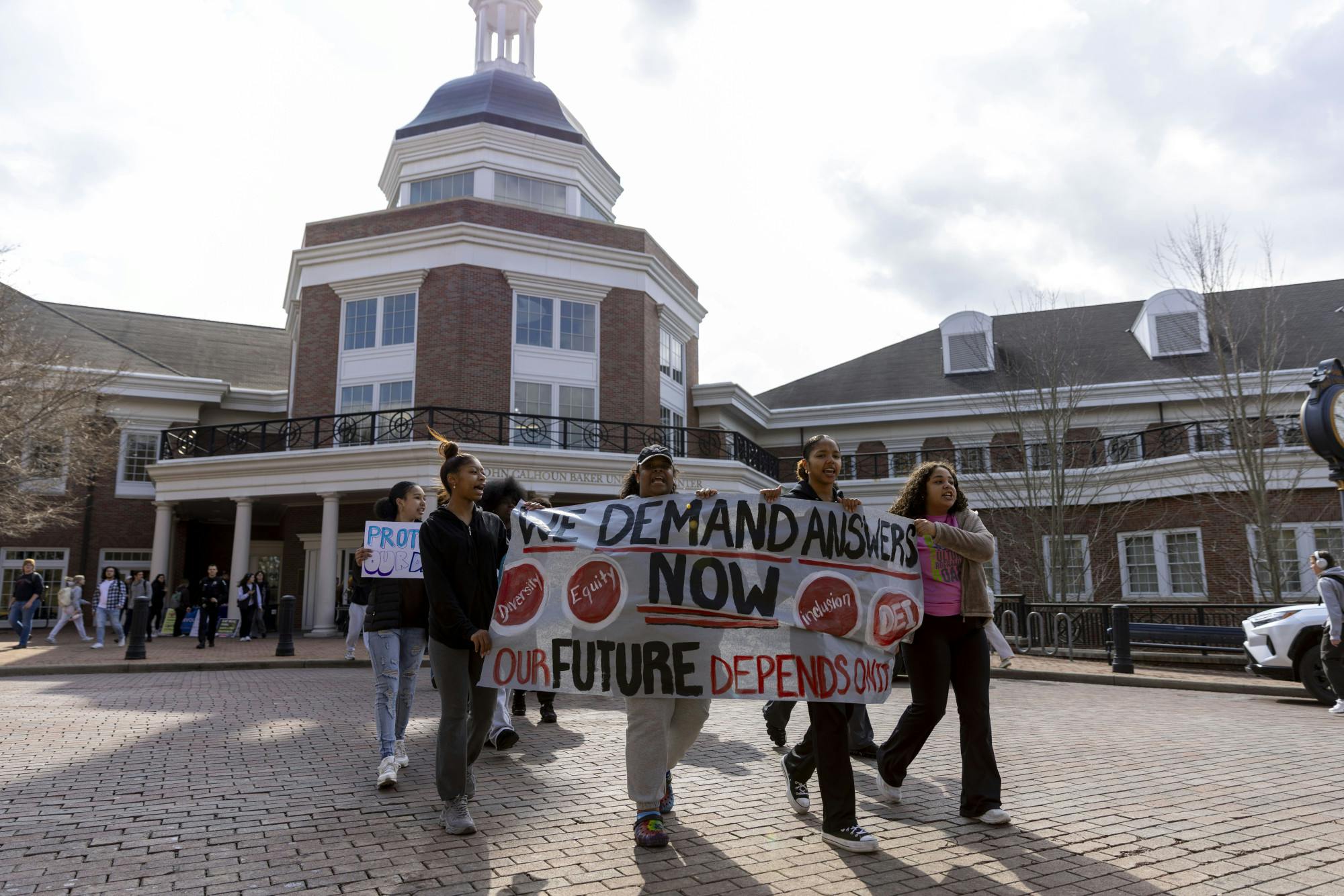
The Foundation for Individual Rights and Expression released its annual report on university speech climates, giving Ohio University a D-.
Each year, FIRE evaluates universities across the country based on anonymous student survey responses about free speech and expression policies. Students answer questions later broken down by categories including race, gender, religion, political ideology and major.
OU’s overall score this year was 61.5%, down 0.3% from 2024. A total of 371 students responded to the survey.
Grades are based on 12 factors: six covering student perceptions of free speech, three addressing university policies and three examining responses to campus controversies. Higher scores indicate stronger free speech climates.
Hans Meyer, director of the E.W. Scripps School of Journalism, said he initially doubted the ranking but reconsidered after reviewing the data.
“It’s a sad state of things when only 11 schools get rankings above a C,” Meyers said. “There’s a lot of improvement that we and a lot of other schools need to make.”
OU ranked 64 out of 257 schools, the same as last year, when it also earned a D-.
FIRE’s report noted 42% of surveyed students said they self-censor at least once or twice a month. The site also estimates there are 1.99 liberal students for every one conservative student at OU.
Because the survey is voluntary, FIRE notes the results only reflect the students who responded, not the entire student body.
Dan Pittman, a university spokesperson, said free expression remains a central part of OU’s mission.
“Freedom of expression is the foundation of an Ohio University education, and we believe that robust debate and civil disagreement — when conducted safely and legally — are signs of an engaged community that can challenge ideals and ultimately help foster growth and community,” Pittman said in an email.
Over the past four years, OU’s scores have remained relatively consistent, receiving 61.4% in 2021, 59.1% in 2022, 61.1% in 2023 and 61.8% in 2024.
OU also received a D in comfort expressing ideas, an increase from past years. Other categories, including openness, self-censorship and administrative support, received a D+ and two D- grades.
Students answered 52 questions in the survey, including “How often do you self-censor during conversations with other students on campus?” and “How comfortable would you feel expressing disagreement with a professor on a controversial political topic in a written assignment?”.
Lily Sellars, a senior studying media arts production, said she has not felt the need to self-censor but believes the university could better support open expression.
Sellars said after the implementation of the Advance Ohio Higher Education Act and the removal of the LGBTQIA+ programs, she has felt change.
“I think they could be more open to supporting other communities,” Sellars said. “It doesn’t have to be a program, but just supporting, I think that would be a good thing.”
FIRE said OU could raise its score by revising campus speech codes and adopting an official commitment to institutional neutrality. The university currently holds a “yellow light” spotlight rating, meaning some policies restrict speech.
Meyer pointed to a university policy that requires faculty members to go through University Communications and Marketing before speaking with the media.
“As a proponent of free speech, I think that is an unfair requirement,” Meyer said. “I think that sends the wrong message to students that the university is trying to control the message too much. It’s not allowing free speech among its faculty.”
Pittman added OU highlights its history of activism and has launched an educational video series on free expression for the campus community.
Meyer said improving campus discourse requires effort from both students and faculty.
“It’s fundamental to our interactions as human beings,” Meyer said. “We just need to learn to be better on both sides of listening to each other and giving each other space to talk and share an opinion without shutting them down.”