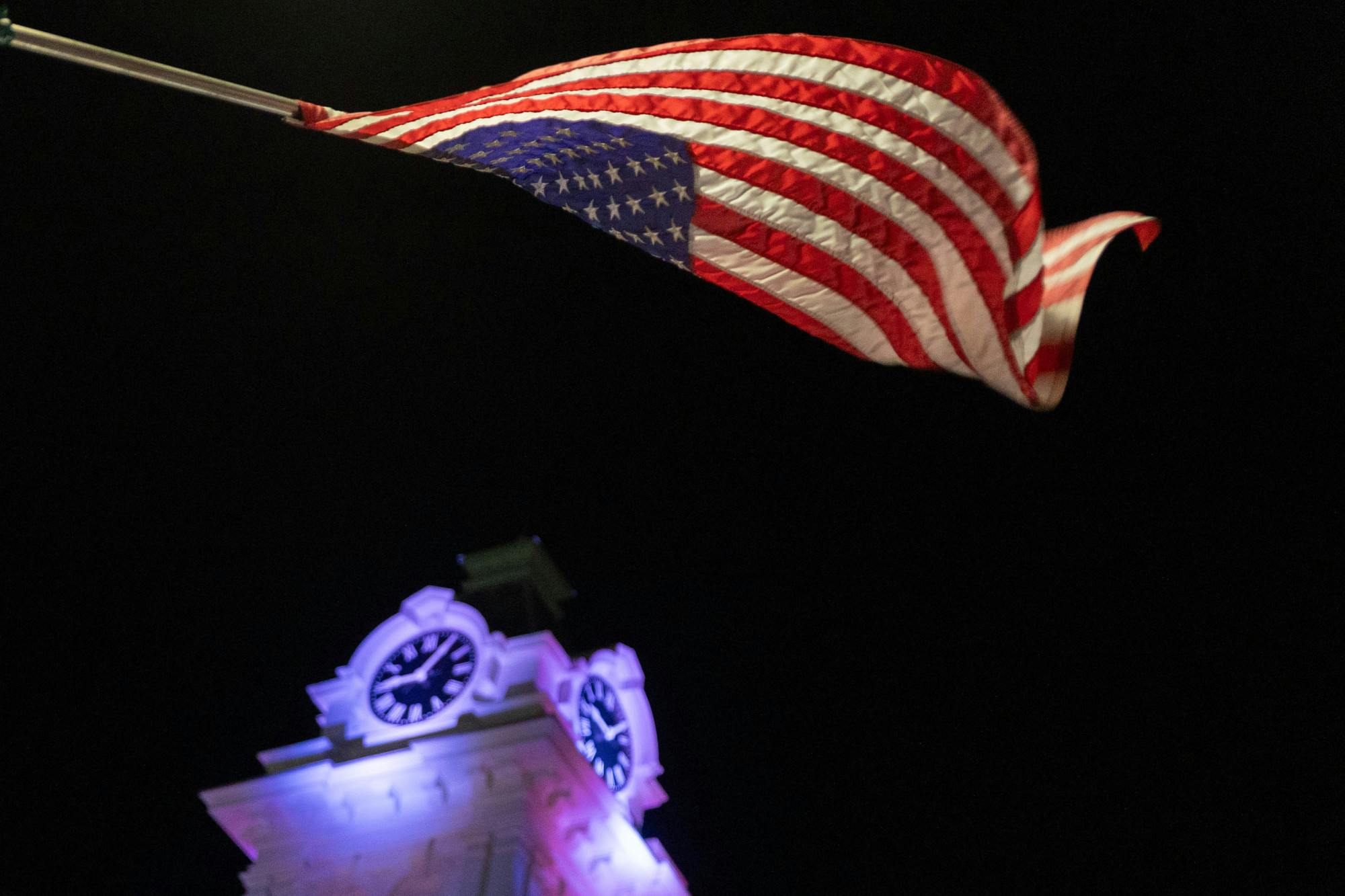
Today marks the 24-year anniversary of Sept. 11th, 2001. Although the national tragedy impacted millions of lives and shook the country, most undergraduate students at Ohio University weren’t around for this event.
However, upon further research and questioning, the trauma is still felt today and affects students in different ways. Not only from the memories parents share with them, but also from the trauma passed down intergenerationally.
Shannon Gray, a psychologist at OU’s Counseling and Psychological Services, says although there is newer and more secure safety, there will always be a quiet fear in recognition of how safety advances came to be implemented. He explains even for people born after 9/11, there are still generational effects and trauma that follow.
“There is a lot of mindfulness for this younger generation around safety, security and not experiencing another 9/11, even though they did not experience what occurred,” Gray said.
Research states Generation Z, many of them too young to have lived through 9/11, is more likely to report poor mental health compared to other generations. A press release from the American Psychological Association states 55% of the generation speaks about feelings of anxiety about the current political climate.
“A broad spectrum of the population is still impacted by that, psychologically or emotionally as a result,” Gray said.
Gray spoke about this as someone who was in high school when the attacks occurred. He recalls how nobody knew it was an attack at the time, and how strange it was to have to navigate and reconcile with something so tragic happening.
“We weren't putting this together in a holistic type of way, but really just the elements of it, until we were more aware of the larger scheme,” Gray said.
He says for people who experienced it firsthand, 9/11 is one of the events they can pinpoint as the biggest and most monumental events in their lifetime, among the same line of events like JFK’s assassination and the Vietnam War.
Gray said the tragedy and weight of 9/11 are still felt by Gen Z through stories and understanding.
“It’s one of those rare events that actually kind of pulls on people in a larger sentiment,” Gray said.
Even through the tragedy, Gray said community was still important following the attacks. He’s encountered the feeling and meaning of community shifting in the decades since.
“I do think there was maybe a broader sense of community, a collectivistic sense of community and connection that was there for a time as well,” Gray said.
But now, Gray says feelings of community are difficult to hold onto.
“We still kind of do connect to some of that when we are paying respect to what happened, but I don’t think it’s the same way,” Gray said.
Even 24 years later, there are still prevalent feelings of distrust and fear. He says even in 20 years, there will always be the long-lasting feeling of fear and anxiety for some people.
Lorelai Blackwood, a high school senior taking college courses at OU, reports the fear regarding 9/11 is still felt today.
“I think that 9/11 made most people extremely wary of each other. As for security, it definitely ramped up significantly because of what happened. Especially in the capital and airports,” Blackwood said via email.
But even with this anxiety, Blackwood says she doesn’t feel any deep connection to the event itself.
Blackwood is not the only student who feels this way. Edie Deberson, an undecided freshman, says she believes “the fear will always be present in a sort of way.”
“I think that due to how traumatic and how much of a drastic impact it had on us as a country, we will always be wary of it happening again or the idea that it could occur again,” Johnson said via email. “I do think that with heightened security and awareness of it has helped to really ease this fear, especially that since implementing these things, it has yet to occur again, and even if it does, we are more aware.”
“There’s always this underlying anxiety,” Gray remarks. “Maybe it’s connected directly back to 9/11…but maybe it’s always there, regardless … there’s always that underlying anxiety that we’re not safe.”