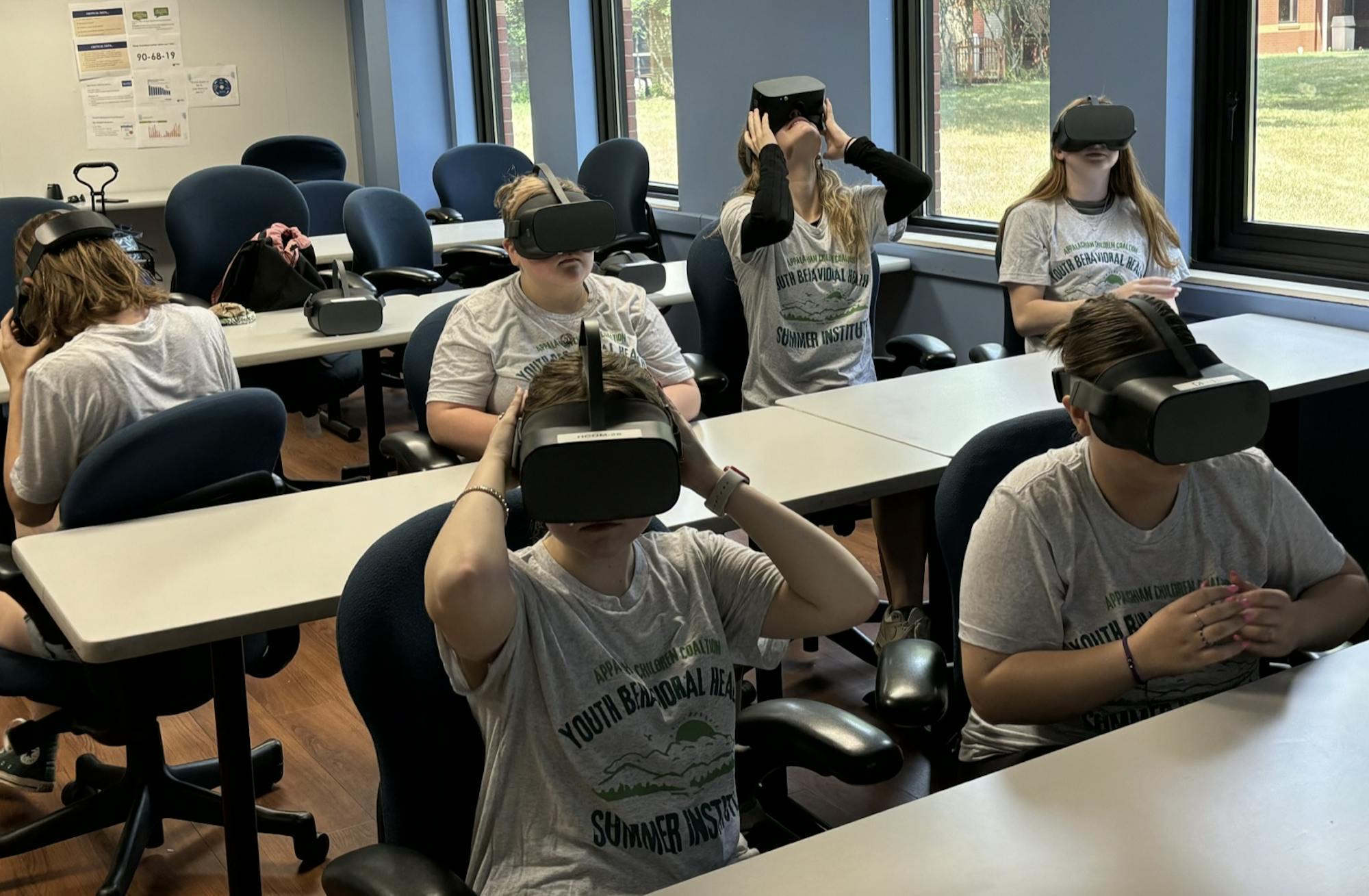
Correction appended: A previous version of this article listed Appalachian Children Coalition as Appalachian Children’s Coalition. The change has been made.
As children and families from Appalachian Ohio travel down a winding road to reach accessible healthcare, a group of passionate and like-minded individuals sits in the passenger seat, guiding the way.
The Appalachian Children Coalition, consisting of nine paid employees and additional volunteers, is a nonprofit organization that advocates for the health and well-being of Appalachian children.
As of spring 2024, only 50 primary care providers exist for every 100,000 people in the Appalachian Ohio region, the ACC states. This number is considered “lower and worse” in comparison to Ohio’s average value of 75 providers. Additionally, a report updated in February states 21.4% of children in the region live below the poverty line.
The Appalachian region spans about 206,000 square miles, housing 423 counties and covering 13 states, according to the Appalachian Region Commission. The size can be daunting for organizations such as the ACC, with countless areas in Appalachian Ohio facing healthcare and poverty concerns.
In an effort to serve Appalachian counties and educate potential volunteers or donors, the ACC teamed up with OU’s Voinovich School of Leadership and Public Service to create a data dashboard.
“It is pretty much a one-stop shop of around 250 indicators … just to provide as much evidence to the region as possible,” Daniel Kloepfer, senior project manager and director of research for the ACC, said. “We wanted to make it as easy as possible for folks in Appalachian Ohio for grant acquisitions, defending programs or understanding where particular needs are in the region.”
Kloepfer, a Bobcat alumnus and Cincinnati native, said it was not until he moved back to Athens to work for Voinovich in 2014 that he saw the challenges those in Appalachia face.
“I started to understand the community and the culture a little better, outside of Cincinnati, outside of Athens itself,” he said. “I worked on a project that had to do with College Credit Plus, and we were trying to increase the number of college credit courses that were accessible to high schools in Appalachian Ohio. That really opened my eyes to the needs of the region.”
Randy Leite, ACC executive director, said the coalition works in 32 counties in Appalachian Ohio covering nearly 40% of the state’s land mass.
“If you look at the Appalachian region, there are a number of challenges that exist,” Leite said. “There are counties with no behavioral health services, no dental services, no primary care. I always talk about the four p’s with Appalachia that are issues … there’s poverty, providers, the place and the people themselves.”
Leite, former dean of Ohio University’s College of Health Sciences and Professions, was the ACC’s first employee, joining the team as director.
“I told the board I would only do it for a year and try to get (the ACC) on solid footing,” Leite said. “But we’ve had so much fun with so many opportunities, the time has flown by.”
Leite said new projects pop up left and right. A recent $64 million grant from Ohio Gov. Mike Dewine’s Appalachian Children’s Health Initiative kick-started the construction of school-based health clinics across 20 Appalachian counties.
“These clinics … will provide primary care and behavioral health care, not just to the kids at the school, but really to everybody in those communities,” Leite said. “We've facilitated about $95 billion of investment in the region and that's to do things like build school health clinics.”
Elizabeth Jones, ACC’s senior director of operations and advancement, said the coalition is working with 16 different healthcare partners for the project and construction must be complete by October 2026.
“That won’t, however, necessarily end the work that we're doing to continue to expand access to healthcare services for youth in Appalachian Ohio,” she said.
Just a couple of the ACC’s additional programs include the AndHealth Youth Well-Being Summit Series and Healthy Meals for Healthy Minds.
“As a nonprofit, we pride ourselves on being very fiscally responsible and operating as a lean organization,” Jones said. “We only have nine full-time staff members, so we wear a lot of hats and have a lot of responsibilities.”
Healthy Meals for Healthy Minds, an initiative started by the ACC in partnership with the Joe Burrow Foundation, the Ohio Department of Behavioral Health and other local partners, battles food insecurity and mental health stigmas in Appalachian Ohio.
The Appalachian Region Commission states nearly 300,000 residents in Appalachian Ohio face food insecurity, with 125,334 households receiving Supplemental Nutrition Assistance Program benefits. Of these residents, 19.7% are children.
“We host one big community event as a food giveaway,” Jones said. “The first two are focused around Thanksgiving, and so we're giving away turkey, potatoes and stuff to make pies and green bean casseroles.”
Jones said representatives from healthcare agencies will attend the giveaways to encourage Appalachian natives to choose nutritious foods and positive mental health practices. Additionally, Robin and Jim Burrow will host assemblies about the importance of fueling the mind and body for students.
The initiative starts Nov. 15 at West Elementary School in Vinton County, continues Nov. 22 at South Elementary School in Stockport and concludes at Wellston Intermediate School in Wellston Dec. 13. Jones said giveaways will run from 10 a.m. to noon, while food lasts.
For nearly five years, the ACC has gathered individuals from diverse backgrounds to accomplish a common goal: transforming Appalachian Ohio. From health initiatives to multi-million dollar projects and educational series, children in the region are in caring hands.
“We want to be a servant to those who serve kids,” Leite said. “I’ve always told our staff, we can gather whatever data we want, but the one thing we should care about is what I call the gratitude metric. There are people out there saying, ‘We are so glad and grateful that you worked with us.’ If we can make people feel we're making a difference in what they do, well then that is the best way to say we're doing important work.”