

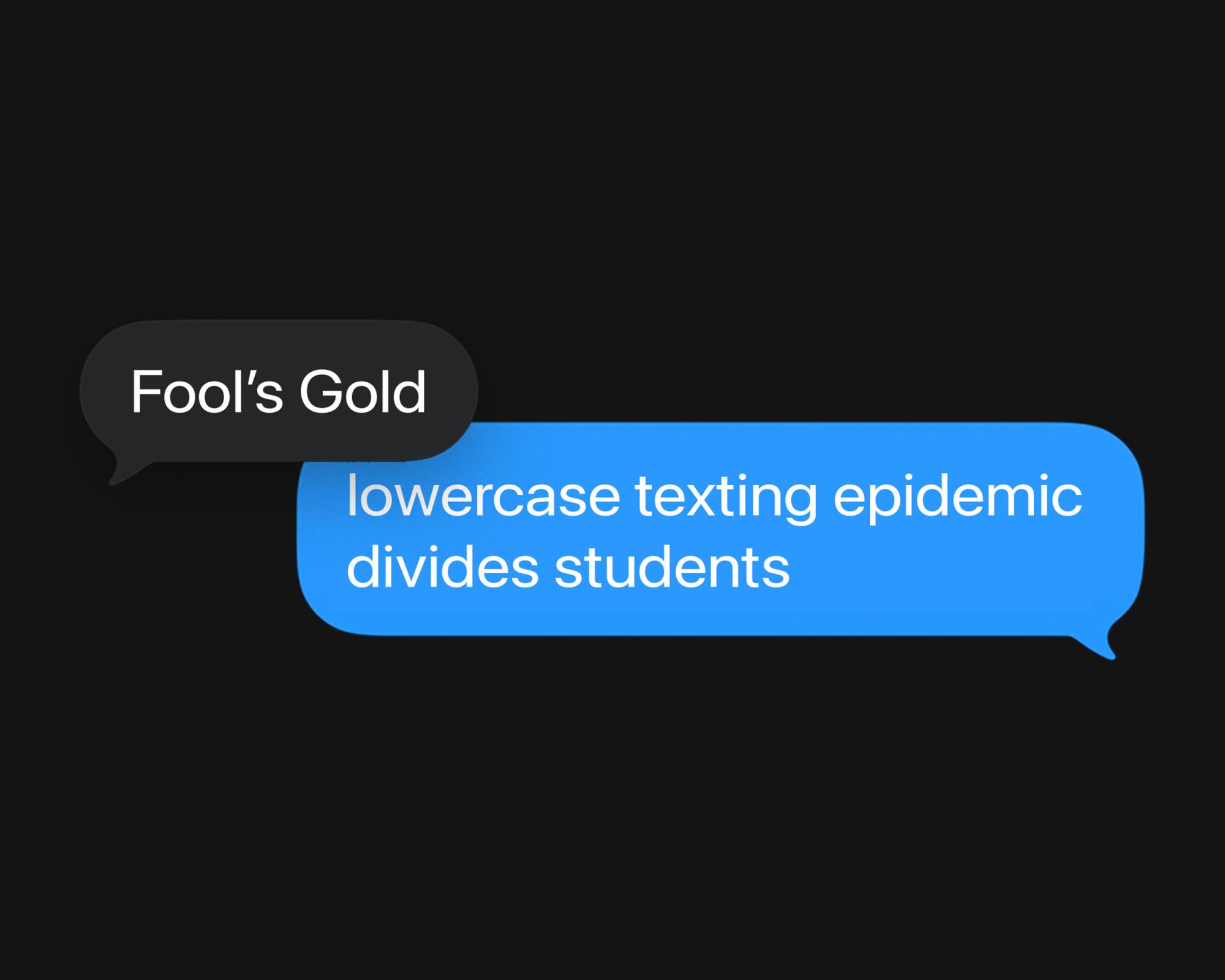
Despite how texting has become an everyday ritual for most, it certainly isn’t uniform. Plenty of people have developed different typing etiquette they tend to use One type of texting etiquette stands above them all as the most prolific due to being part of how every message is constructed: the epidemic of lowercase-only typing.
This style of texting is quite simple to understand, as letters that would be capitalized anywhere else are instead made intentionally lowercase. This quirk stands out among others due to how common it is, how it’s purposely done and how heated it makes both defenders and critics.
In my experience, about half of the people I message seem to employ this lowercase-only style. Typing like this requires turning off the automatic capitalization function in system settings; otherwise, words will be capitalized automatically.
I choose to type with uppercase characters included. Doing so helps my speech feel more formal, as if it’s to be taken more seriously. Despite my personal thoughts on the matter, I seldom notice if others type with uppercase or lowercase-only characters, which makes me feel as if it is a rather even split between those who opt for either option.
Despite not being bothered by others’ use of capitalization or not, I do make a deliberate effort to uphold the standard for myself. When editing a sentence I typed, I make a subconscious effort to keep proper capitalization in place where professionally necessary, even though it is not required in the informal context of messaging others.
Katharine Barlay, a freshman studying media arts production, sees the issue as a matter of maturity among peers. “We're grown at this point,” Barlay said.
Barlay also remarked that proper capitalization, even in informal contexts, helps her “feel more well-spoken.”
Although I agree proper capitalization helps make what I have to say feel more impactful, it being a mark of maturity is something I had not considered. This is echoed by others’ thoughts on the matter, even by those who are pro-lowercase only.
Some who use lowercase-only typing seem to change the format based on context, such as Piper Blair and Klaire Rocazella, who are both freshmen studying film. Blair said she would only tend to employ traditional capitalization when “talking to somebody who is in a position of respect or authority,” but feels freer to use informal capitalization when messaging with friends.
Although I can understand the choice to change typing style based on context, I can’t help but feel that doing so requires a lot more effort and potential for mistakes than keeping things consistent across the board. I do tend to make my emails more formal than my texts, for example, but I feel secure in knowing that, at the very least, I would not make obvious errors when sending an email. Code switching has its clear downsides.
Rocazella went on to argue typing style is more than just a preference, as it can help portray tone more efficiently. “It can be hard to (communicate tone) over text, and using the difference between uppercase and lowercase can kind of help.”
I agree that portraying tone is often a challenge over text, and thus using capitalization or lowercase text to help illustrate different tones is perhaps the most useful of all the discussed reasons. Using either in moderation to help extend what the text is saying and how it is being said can be one’s priority. Ultimately, when it comes to messages, getting across the actual message should be what is most important.
While the matter of uppercase versus lowercase-only texting is a rather split issue, it’s still an interesting one to discuss, even if conversations can get heated quickly. If nothing else, both typing with uppercase letters and in entirely lowercase are not quite as disliked as typing in all capital letters.
Logan Bauer is a freshman studying film at Ohio University. Please note the opinions expressed in this column do not represent those of The Post. Want to talk to Logan about his column? Email him at lb324324@ohio.edu.


