

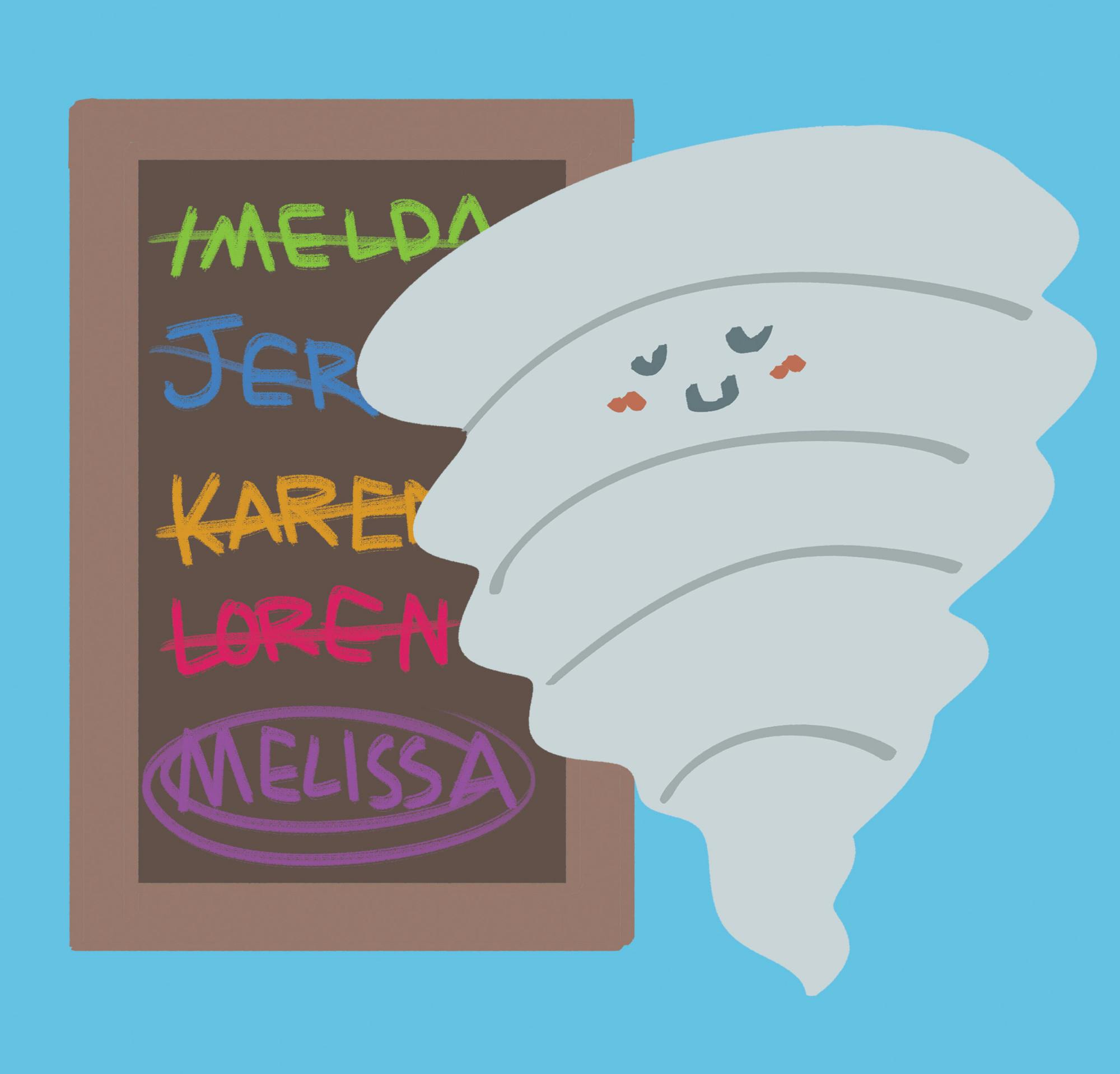
The Atlantic hurricane season began June 1 and ends Nov. 30. Although hurricanes are unpredictable, their names are not. In fact, the reason hurricanes have names is much more complicated than expected.
The tropical cyclone naming system is controlled by the World Meteorological Organization. Although naming systems vary around the world, they all aim to serve the same purpose: clear and fast communication.
There are several factors the WMO considers when selecting names for tropical storms and hurricanes, including, “Short in character length for ease of use in communication, easy to pronounce, appropriate significance in different languages (and) uniqueness, (as) same names cannot be used in other regions.”
This practice began in the North Atlantic in 1953, introduced by meteorologists in “pursuit of a more organized and efficient system.” Male names were introduced to the system in 1979, breaking the traditional practice of using only female names for storms.
Today, hurricanes in the Atlantic Ocean, Caribbean Sea and Gulf of Mexico are named by rotating alphabetical lists of 21 names, skipping letters Q, U, X, Y and Z, alternating between male and female names. Each list is repeated every sixth year.
If the list is exhausted in a given year by an extremely active hurricane season, then the Greek alphabet is used. This happened twice, once in 2005 and again in 2020. This changed in 2021, and now a list of supplemental names is used.
Dillon Blount, an assistant professor of geography at Ohio University, graduated from the University of Wisconsin-Milwaukee with a doctorate in atmospheric science last May. He explained the logic behind naming hurricanes.
“The primary focus or goal of naming storms is to keep them separate so we know which one we are talking about when we’re putting together messaging about what the impact could be from the storm,” Blount said.
Distinctive, short names prevent confusion and streamline the communications process. Last season, Hurricane Helene and Hurricane Milton made landfall in the Florida Gulf Coast two weeks apart.
While Helene was making landfall, Milton was approaching Florida. Residents of the impacted areas needed to stay updated on the status of both storms, a task that would have been nearly impossible without the designation of names.
In cases of concurrent or clustered storms such as this, the naming system provides a clear separation on broadcast and emergency communications. For the same reason, certain names are retired.
“If (a storm) causes enough destruction, especially to property and loss of lives, (the WMO) will retire that name and will never use that name again,” Blount said.
Helene and Milton were both retired as names in 2024. Other names that have been retired include Katrina, Sandy and Harvey. If a name is retired, it is replaced on the list by a name of the same first letter. There have been 99 names retired from the Atlantic list since 1953.
There have been 13 named storms in the North Atlantic this year, including Hurricane Melissa.
Melissa first made landfall in Jamaica on Oct. 28 as a Category 5 and hit both Cuba and Haiti in the following days. At the time of publishing, Melissa’s death toll is 60 and counting, according to USA Today. The name Melissa will likely be retired as a result, according to Blount.
The naming of hurricanes has saved countless lives. This decades-old practice demonstrates how implementing systems of clear and purposeful communication is key during disaster response and recovery. Although it may seem inconsequential, the naming system illustrates how simplicity is sometimes the best answer.


