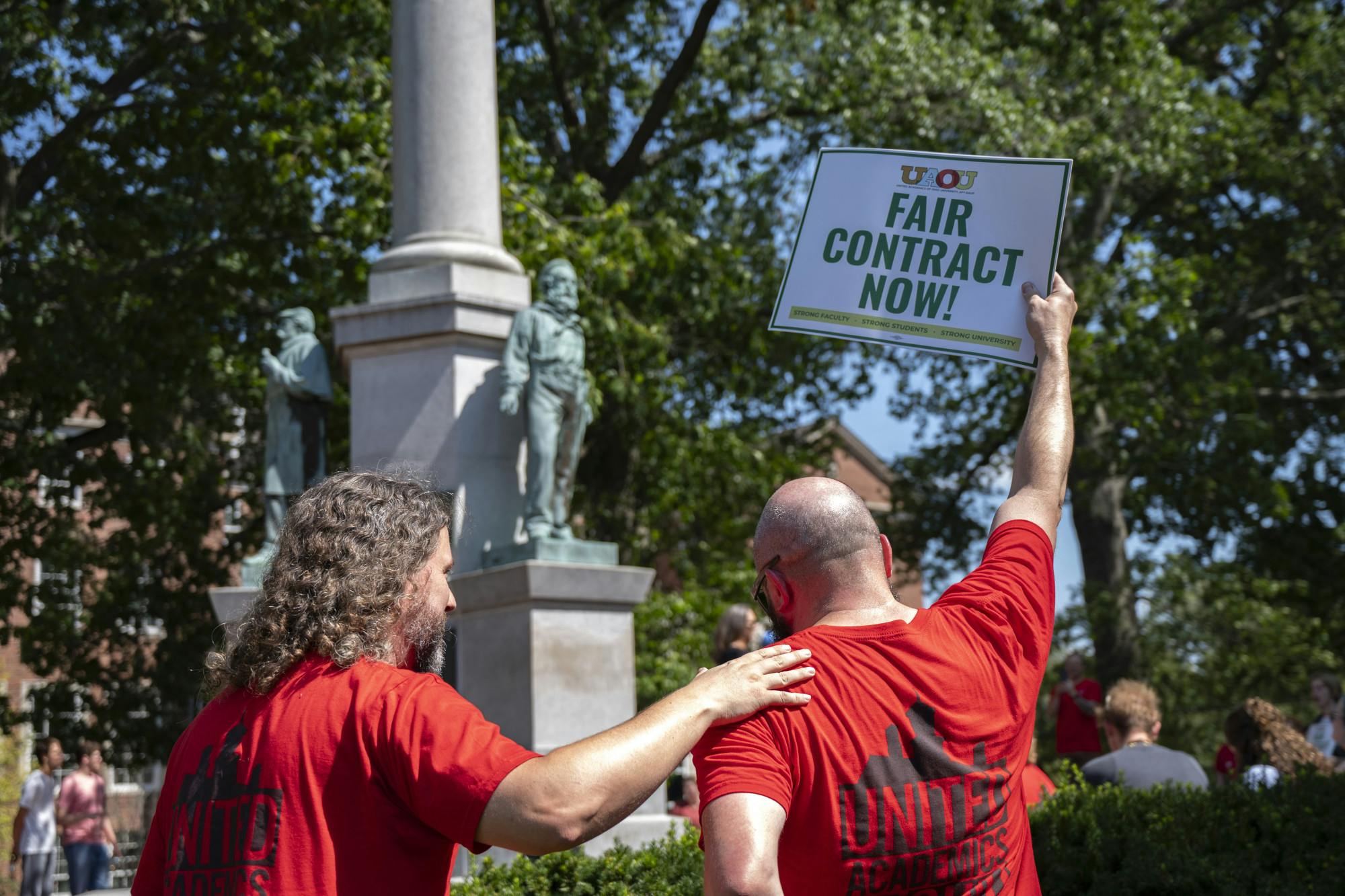
Faculty salaries at Ohio University have declined relative to peer institutions over the last 12 to 15 years, prompting the United Academics of Ohio University to demand an 8% annual raise amid an ongoing contract stalemate.
While the administration has offered a 2% counteroffer and declined to discuss specifics due to active collective bargaining, in accordance with Ohio collective bargaining laws, faculty point to widening gaps between university pay compared to peer institutions and growing administrative compensation.
According to Joe McLaughlin, an associate professor of English at OU and a member of the UAOU bargaining team, OU has historically competed with public institutions like Miami University and University of Cincinnati in terms of faculty compensation. McLaughlin said OU has now fallen from the top quartile of Ohio public universities for faculty pay to the bottom.
McLaughlin believes a reason for the slip is that, over that period of time, all competing institutions in Ohio, with the exception of Miami, which more recently unionized, and Ohio State University, for its size, had faculty unions. That is also what inspired UAOU.
“One of the big causes of our efforts and the desire of an overwhelming majority of faculty to unionize is that they saw, as they looked around the state, that faculty at other schools had,” McLaughlin said. “ I don’t know if they were actually keeping up with inflation, but they were doing a lot better in terms of inflation than we were.”
The university’s counteroffer of a 2% raise is below the current rate of inflation, which was 3.4% in August.
However, the university faces pressures from the state due to tuition freeze laws or caps, which limit how much the university can increase tuition year-to-year. In Ohio, tuition cannot increase more than 3%, which is also below the current rate of inflation. That cap limits revenue for universities and can create budgetary pressures, according to a Georgetown University report.
McLaughlin also criticized the university’s counteroffer for not including payback for the raises faculty could not receive in the past two years due to ongoing negotiations.
“They have been telling us consistently that we will get what everybody else gets,” McLaughlin said. “But when it came to their compensation counteroffer, they actually offered us something that’s worse than all other university employees have received over the last two years.”
Because the university and UAOU are currently engaged in collective bargaining, the university could not comment on specific salary analyses or characterize individual bargaining proposals outside of the ongoing negotiation process.
However, Dan Pittman, the senior director of communications for OU Communications and Marketing, wrote in an email that the university is determined to reach a compensation agreement.
“The University remains actively engaged in the bargaining process and focused on reaching a contract that supports faculty, advances OHIO’s academic mission and contributes to long-term institutional success,” Pittman wrote in an email.
According to John O’Keefe, an associate professor of history at OU’s Chillicothe campus and director of communications for UAOU, Miami University went through a process similar to UAOU’s, but received a compensation increase higher than UAOU’s initial proposal.
“They got a 9% increase that also applied to the year that the negotiation started, so they also got back pay,” O’Keefe said. “We are actually proposing less than what Miami received.”
O’Keefe also commented on OU lagging behind all its peers, not just Miami.
“If the trend continues, currently Wright State is ahead of us, but we will be the lowest paid of all the four-year institutions in Ohio, public institutions,” O’Keefe said.
Another trend involving faculty salaries at OU is gaps between departments. Faculty teaching in market-driven schools earn significantly more than faculty teaching in liberal arts and fine arts.
According to Ohio University's Compendium of Faculty Salaries during the 2025-26 school year, the average pay for tenured or tenure-track professors for the College of Business is $162,671 and $145,433 for the Russ College of Engineering and Technology. In comparison, the average pay for tenured or tenure-track professors in the Chaddock and Morrow College of Fine Arts is $101,633. The Voinovich School for Leadership and Public Service has the lowest average annual salary for tenured professors at $89,070.
McLaughlin states those differences have always existed as a result of market economies and are not a concern for UAOU.
“The union is in no way trying to address those kinds of disparities,” McLaughlin said. “When we talk about our salaries depreciating in relationship with our peers, that’s really happening across the board.”
There is also a pay gap between administrators and faculty.
According to OU’s Salary Database, the top 10 highest salaries earned at OU are not earned by professors. The database was updated March 12, and includes all non-student employees’ base salary as of Dec. 31, 2025.
McLaughlin noted this gap has always existed, but not in the way it is today.
“I think what we've seen in the university is what we've seen on a pretty wide scale in society is that the gap between the people at the very top and most of the other people, that gap is growing,” McLaughlin said. “If at one time top administrators were making two, three times as much as a typical faculty member, now it's probably more like five and 10 times as much.”
According to McLaughlin, the administration justifies those high salaries using peer benchmarks of other universities.
“They’re very interested in benchmarking executive salaries, but they don’t want to engage when we say ‘OK, what about benchmarking our salaries in relationship to other people?,’” McLaughlin said.
O’Keefe also shared his perspective on the administration-faculty pay gap.
“I think this is a structural issue where we see those pay increases coming in at the top and we don’t see them at the bottom,” O’Keefe said. “And that shows where the university priorities lie.”
McLaughlin said UAOU’s proposed 8% salary increase would be necessary to get even with UC and be third in the state for faculty salaries.
“This is where we should be,” McLaughlin said. “This is where we’ve been historically…Three years of approximately 8% raises would catch us up.”