

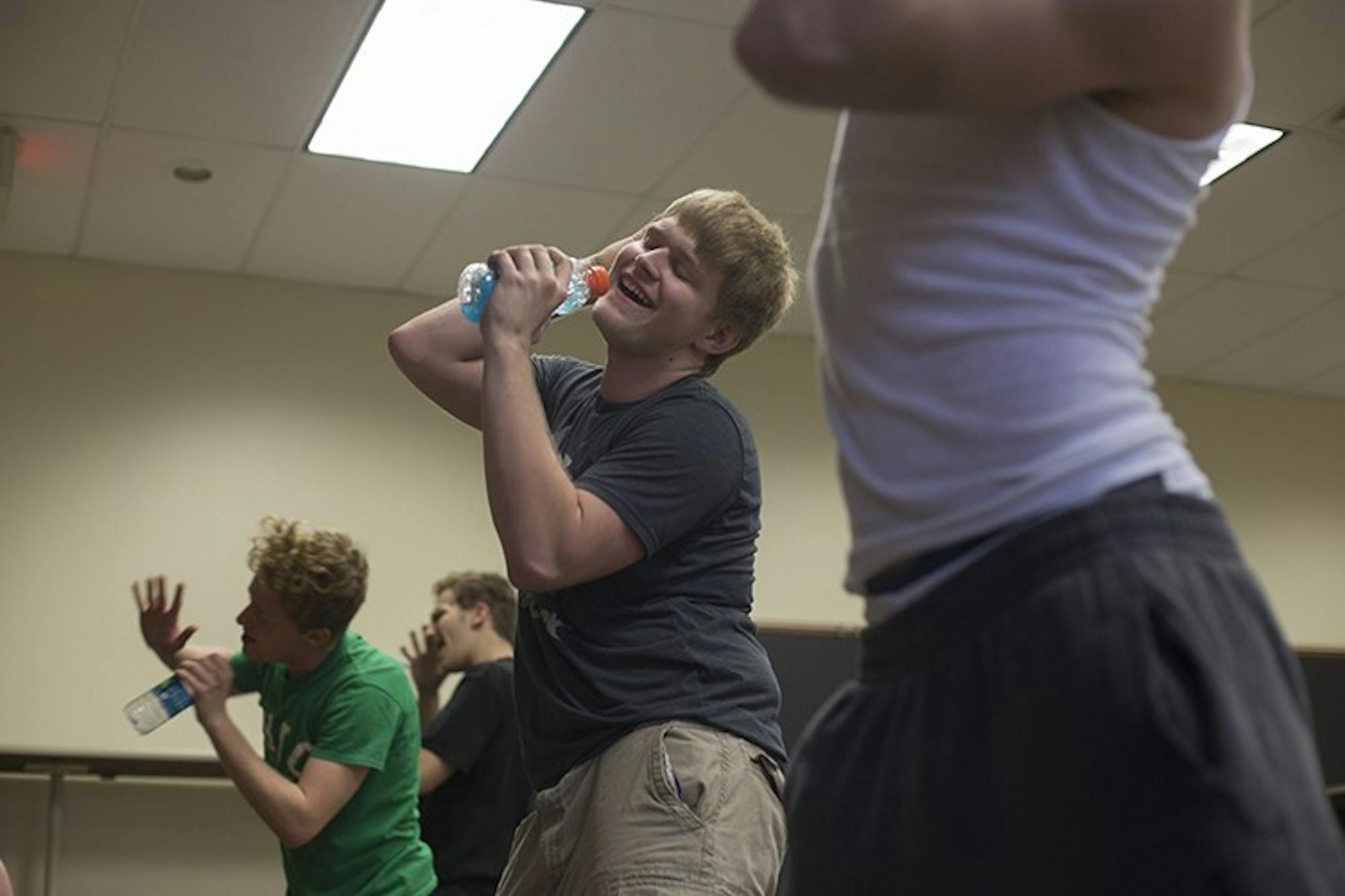
When the Lost Flamingo Company opens the curtains for its spring musical, it will be the first time Michael Mayberry has been on stage since kindergarten — he played the donkey in the story of Mary and Joseph.
Now, Mayberry, a freshman studying English in the Honors Tutorial College, is playing Melchior Gabor, the male lead in Spring Awakening, a rock musical about German adolescents in the late 19th century who struggle with sexual desires that they have no knowledge on how to handle. Melchior knows more than others because of what he reads in books and is rebellious against the restrictive society.
Sexuality is only one of the many issues the show tackles. Abortion, homosexuality, child abuse, underage sex and suicide are all discussed as well.
Even though this is his first time on stage in years, Mayberry said he isn’t hesitant or nervous about the material.
“Even though some very adult things happen, they’re all things most teenagers have had some sort of experience with or some knowledge of,” he said. “That’s why I think the show is so important. … It’s raw and unapologetic. … It feels real to the teenage experience.”
Though there do not seem to be many issues with the material by today’s standards, the original play version saw a lot of censorship. Written in 1891 by Frank Wedekind, Spring Awakening was censored until about the 1980s, when regional productions started to become “common,” according to an article from New York Magazine. The show was banned in Britain until 1963, and even its first production was heavily censored.
Lorraine Wochna, a reference librarian in Alden Library, said she was in the play version around 1977. She played Wendla, the female lead and character at the heart of many of the issues tackled.
“Even then, I wondered why it was racy,” she said.
Lincoln Sklar, the director of LFC’s Spring Awakening, said the company tries to not shy away from any topic, citing their productions of Rent and The Rocky Horror Picture Show. Nevertheless, Sklar said when LFC picked the show, they decided they would cut the nudity featured in a key scene.
“There’s nothing wrong with it, but it doesn’t fit our production,” said Sklar, a senior studying journalism. “We didn’t want to drive away the audience or people from auditioning. … We’re trying to be our own production and not do exactly what the Broadway production does.”
Though LFC has made that change, Dennis Delaney said the Division of Theater doesn’t censor shows.
“We’ve done shows with very adult content, nudity and handled sexuality,” said Delaney, chair of the season selection committee. “It’s never been an issue here. We’re lucky that way. … All of the faculty are in the professional theater world, and it would never occur to us to try to clean up or censor for students. We feel they’re adults.”
Merri Biechler, managing director of the Brick Monkey Theater Ensemble, Southeast Ohio’s professional theater company, said neither the company nor she as a playwright has ever felt the need to censor in Athens.
“I think we have an incredibly supportive community,” she said. “That’s why I think it’s great that different student groups do The Vagina Monologues every Valentine’s Day. It’s seen as controversial but the meaning and support around it are more important than perhaps someone taking offense to it.”
A Spring Awakening history
•Frank Wedekind wrote the original
Spring Awakening play, subtitled “A children’s tragedy,” in 1891; the first production was in 1906 and was seriously censored
•The U.S. premiere in 1917 almost didn’t take place because the New York City Commissioner of Licenses tried to shut it down, but a court injunction kept it running
•1963 saw the first production in Britain, after a ban had finally been lifted, though the Lord Chamberlain heavily censored it because he inspected all theater scripts until 1968
•In 1986, the new theater director, Bill Glassco, at Toronto’s CentreStage used actual teenagers for the first time and caused quite a stir
•The musical adaptation, with book and lyrics by Steven Sater and music by Duncan Sheik, opened on Broadway in 2006 and went on to win eight Tony Awards in 2007 including Best Musical
@buzzlightmeryl
mg986611@ohiou.edu


