

Editor’s Note: This is part two of a five-part series about Vernon R. Alden Library.
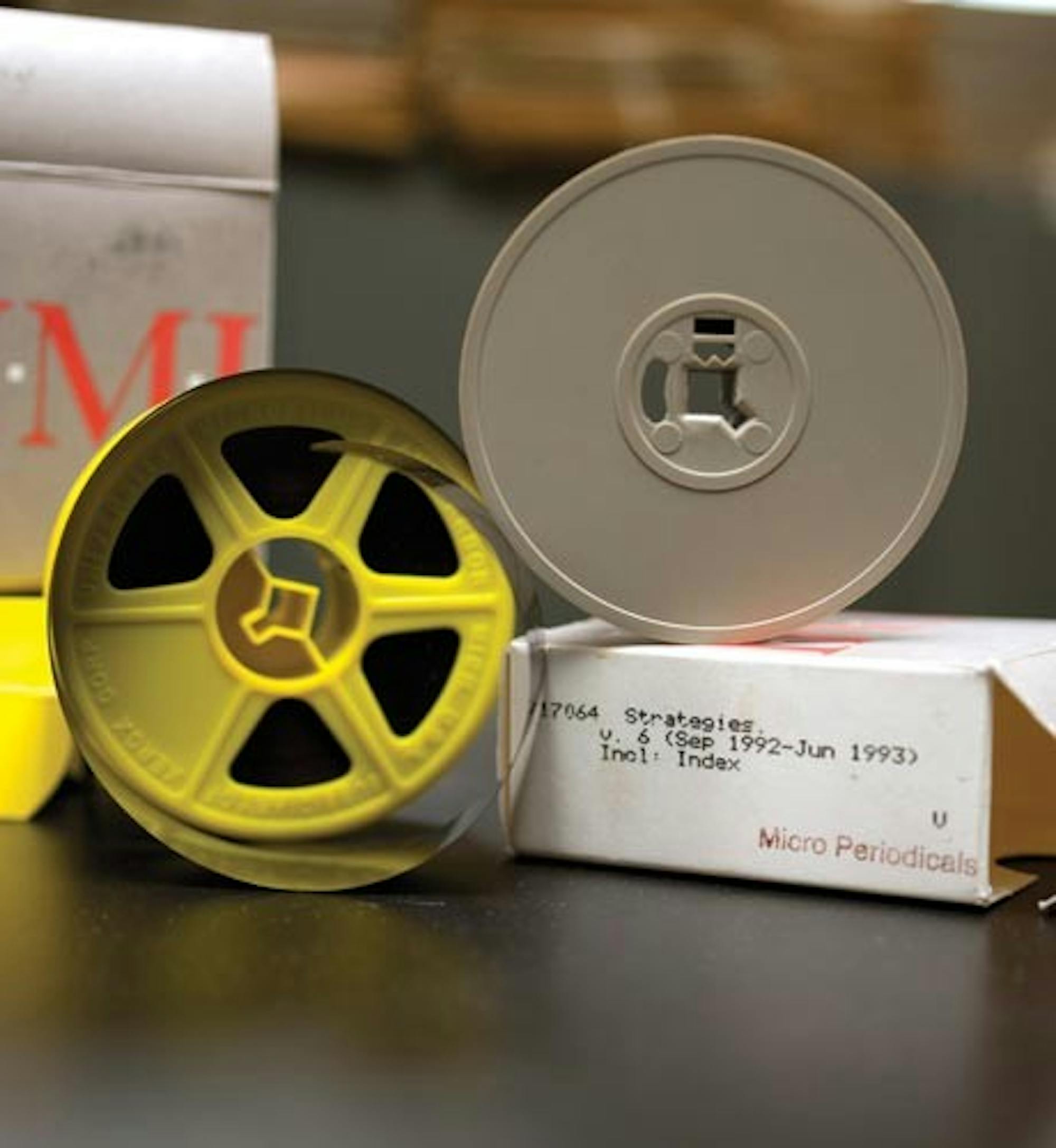
In contrast to Alden Library’s computer-dominated second floor, a corner of its first floor is filled with machines that look like they’re from the 1980s and file cabinets packed with millions of sheets, each containing tiny photographs.
The sheets, known as microforms, are hard copies of journals and newspapers, such as The New York Times and The Washington Post, which can only be read using special micrographic machines. In recent years, however, Alden began offering copies of many newspapers and journals in electronic form and getting rid of some of its microforms.
“We notice that the print just doesn’t get used anymore,” said Scott Seaman, dean of Ohio Universities Libraries.
Last spring, OU donated The New York Times microform to Notre Dame College of Ohio in South Euclid. Smaller universities and colleges do not have the money to purchase either the microform or electronic versions of newspapers and other items, said Kelly Broughton, assistant dean for Research and Education Services.
When asked why the library did not sell the microform, Seaman chuckled.
“I don’t think there is a market for them,” he said.
Giving The New York Times microform away is just one instance of the library’s slow shift from tangible to electronic forms of media.
“It’s a huge improvement as far as access to the materials,” Broughton said. “You don’t have to come to Alden.”
During fiscal year 2010, OU paid $3.4 million for access to electronic forms of audio, journals and videos, among other items.
Electronic forms of media are accessible from any location and offer easy search options, Seaman said, admitting that electronic forms are more costly, and OU does not own much of the content.
“It is much more common to lease (electronic) access,” Seaman said. “It is very much like cable television.”
Student Senate Vice President Matthew Beddingfield, who was on the University Library Committee last year, said he did not know OU gave away The New York Times microform but said that offering the newspaper electronically was “a good idea.”
“(Electronic formats) can’t hurt, only help,” Beddingfield said, referring to OU students as “tech-savvy.”
The move toward electronic formats is also environmentally friendly because it saves paper, he added.
Not only have students and faculty requested that more media be provided electronically, but publishers have begun offering more of their content in an electronic form as well.
“There is a wide migration by publishers to electronic format,” Seaman said, adding that about 75 percent of journals are now offered only electronically.
“Our web page is increasingly our front door,” he said.
Although Alden will continue to expand its electronic archives, Seaman predicted that print is “not going anywhere anytime soon.”
cb119506@ohiou.edu
@ThePostCampus


