

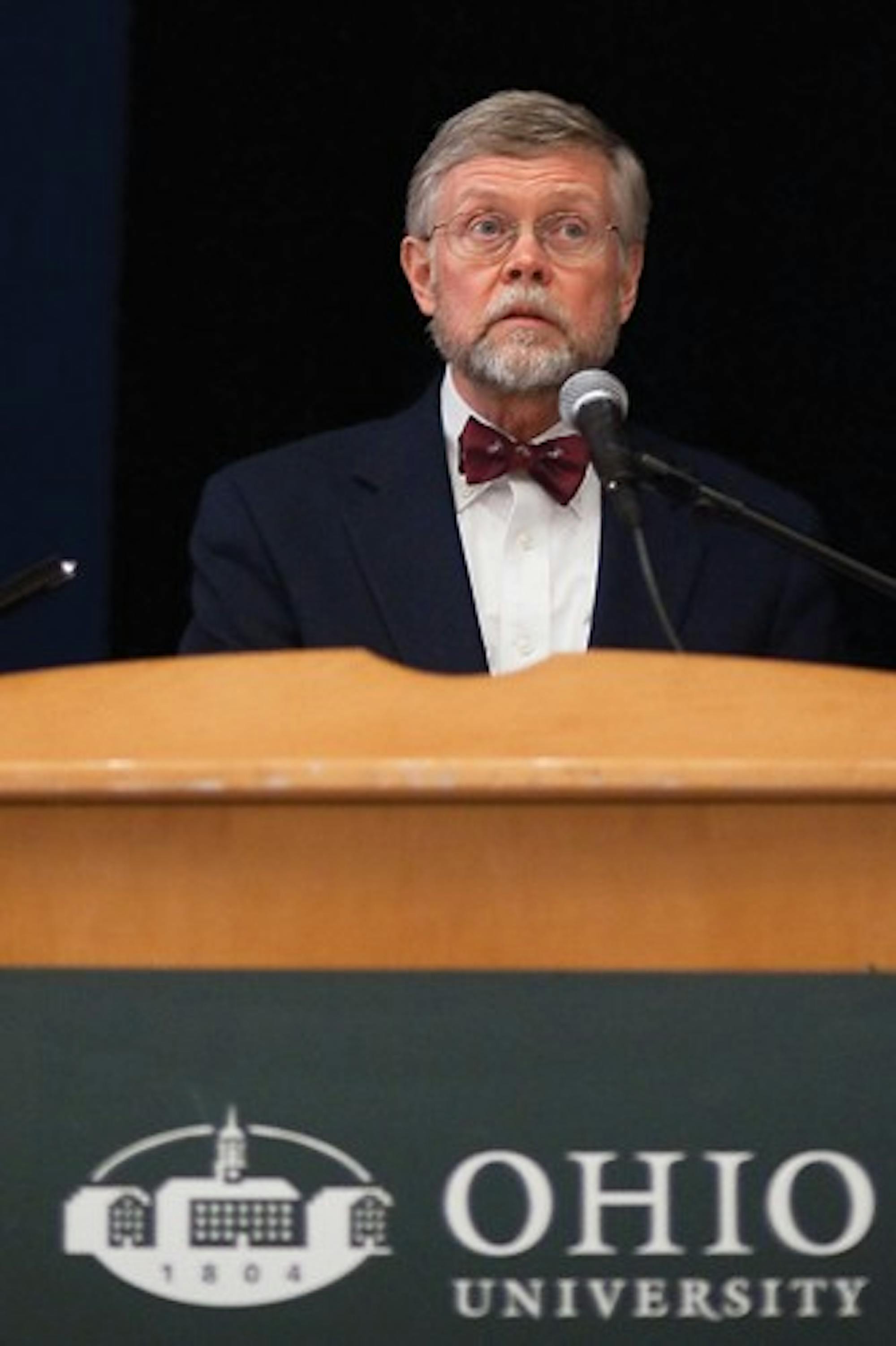
A professor reminded Ohio University students last night that the historical perspectives of “paradise” were affected by forgotten wars.
In a packed Baker University Center Theater, Fred Anderson, a history professor from the University of Colorado at Boulder, spoke about war and peace and the relationship between the two.
“History is judged about what is not in it, but what is left out,” said Anderson, who has studied and taught at Harvard University.
He described that the World War II and Lincoln memorials in Washington, D.C. include inscriptions that describe the wars they represent, but the Vietnam Veterans Memorial does not and only communicates the human cost of war through a list of victims’ names.
The wars the U.S. fought were to extend and preserve freedom, Anderson said.
“(These) wars punctuated our received grand narrative,” he said.
While history provides images of America’s major wars, many wars are not as well documented.
Several wars have been forgotten, he said. These include the War of 1812, the Mexican-American War, the Spanish-American War and the Indian Wars.
“The colonial period is often brushed over but takes up half of American history,” Anderson said.
Many travelers who traveled to the West called the place paradise but did not realize the cost of “paradise” was caused by war.
He explained that this period should be incorporated in a more systematic way.
Anderson said his goal was to outline a narrative of past military interventions that have parallels today.
Empires are most successful with the cooperation of people, he said, adding that U.S. expansion was rooted in a desire for worldwide stability.
“The grand narrative explains the persistence of an empire,” Anderson said.
Now, he said, leaders must live up to the ideals of liberty and freedom with further expansion.
“It was most interesting when the speaker talked about the things we don’t know about history,” said Ali Petrulis, a freshman whose major is undecided. “He talked about a lot of things I’ve never heard about in history class.”
sf339111@ohiou.edu


