

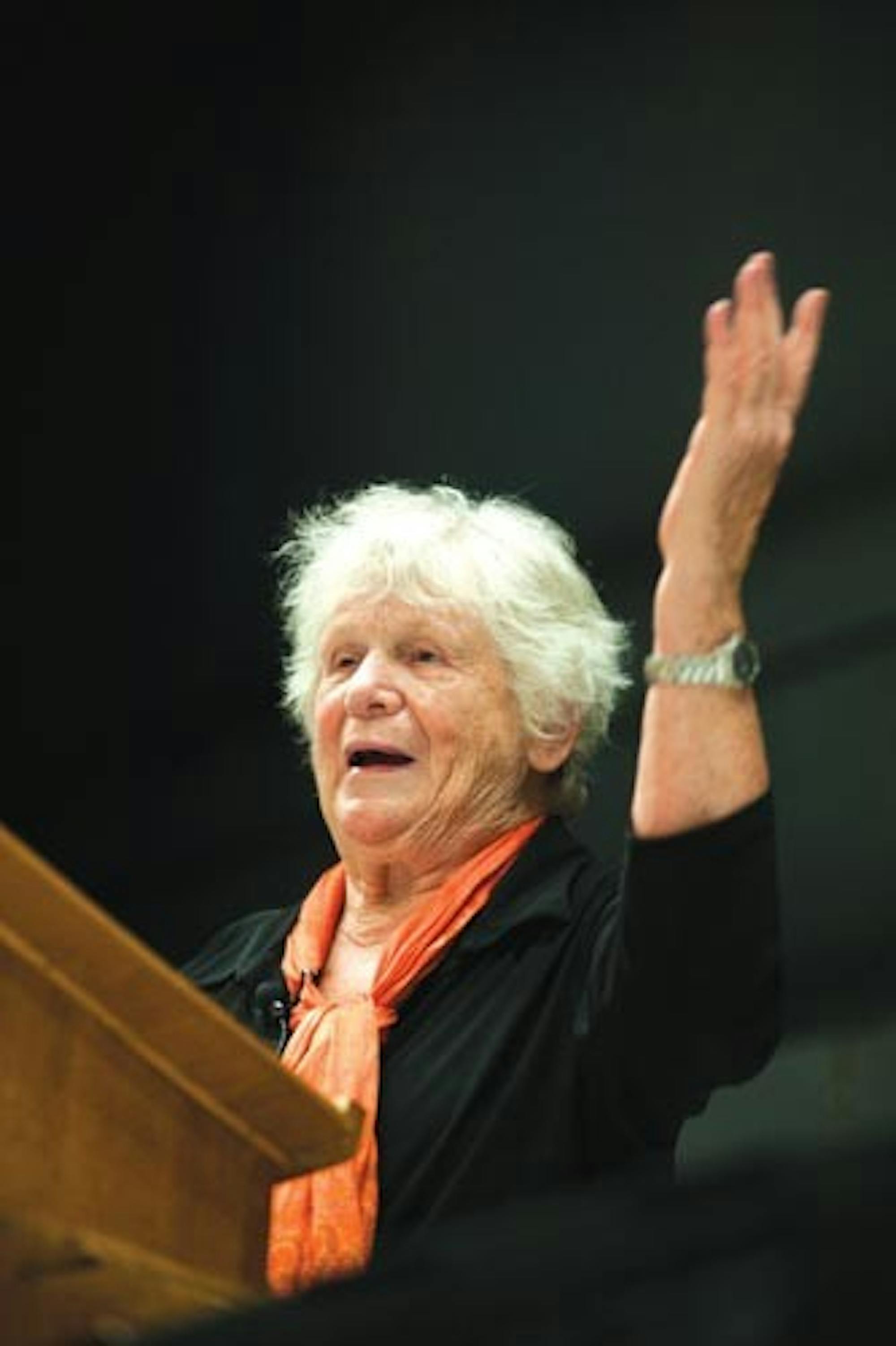
A nationally renowned advocate for education reform presented to local educators Monday, promoting a collaborative power structure in lieu of the current top-down system.
Deborah Meier, who has had 45 years of experience in K–12 public education and is the author of several books, spoke at Federal Hocking Middle School and Ohio University’s McCracken Hall throughout the day.
Meier is the recipient of the OU Patton College of Education 2012 Hick’s Executive-in-Residence award and is the first educator to receive a McArthur “Genius” award.
Patton College’s annual award “recognizes outstanding leaders in education.” Meier was selected because of her “contributions as a teacher, principal, award-winning writer and public advocate,” according to a university news release.
“She has an outstanding record of being an advocate for public schools,” said Cindy Hartman, an instructor in the Patton College and the associate director of the Coalition of Rural and Appalachian Schools. “She has done extensive writing and lecturing on the topic, and she’s just been really successful in her career.”
Meier’s lecture, titled “The Power of a Teacher,” focused on rethinking structures of power in academia and encouraging collaboration among teachers, parents, students and administrators.
“It’s important to be able to disagree but still respect,” Meier said. “There is no point in the complexity of democracy if we don’t accept that others’ ideas might be right.”
She advocated for a democratic process for the schooling system in which teachers, students and parents would have more power than those who have little educational experience yet hold the majority of the power.
“Faculties in schools are treated as if they were children in the school,” Meier said. “Schools are a place where even feisty, smart adults won’t be able to be a troublemaker.”
Meier recalled never having a vote in school affairs during her many years in faculty meetings, something she said was comparable to a teacher’s presenting to a class without considering the needs and desires of her students.
“The people who are affected should have the most to say,” she said. “The people who know the least about the kids are the ones making all of the decisions.”
Meier cited Michael Bloomberg, the mayor of New York City, as an example because, in the Big Apple, there is no school board, she said. The mayor makes all of the decisions for the students in the 1.2 million-person city — despite his lack of experience in education, Meier said.
Part of the problem, she said, is that elementary- and high-school teachers are often thought of as not having important or particularly difficult jobs.
“You don’t argue with (a school-board member); you say, ‘Oh, thank you, I’m sorry … tomorrow will be the day of change,’?” Meier said. “I think that’s part of our culture that allows them to take our professions away from us.”
— Pamela Engel contributed to this report
ld311710@ohiou.edu


