

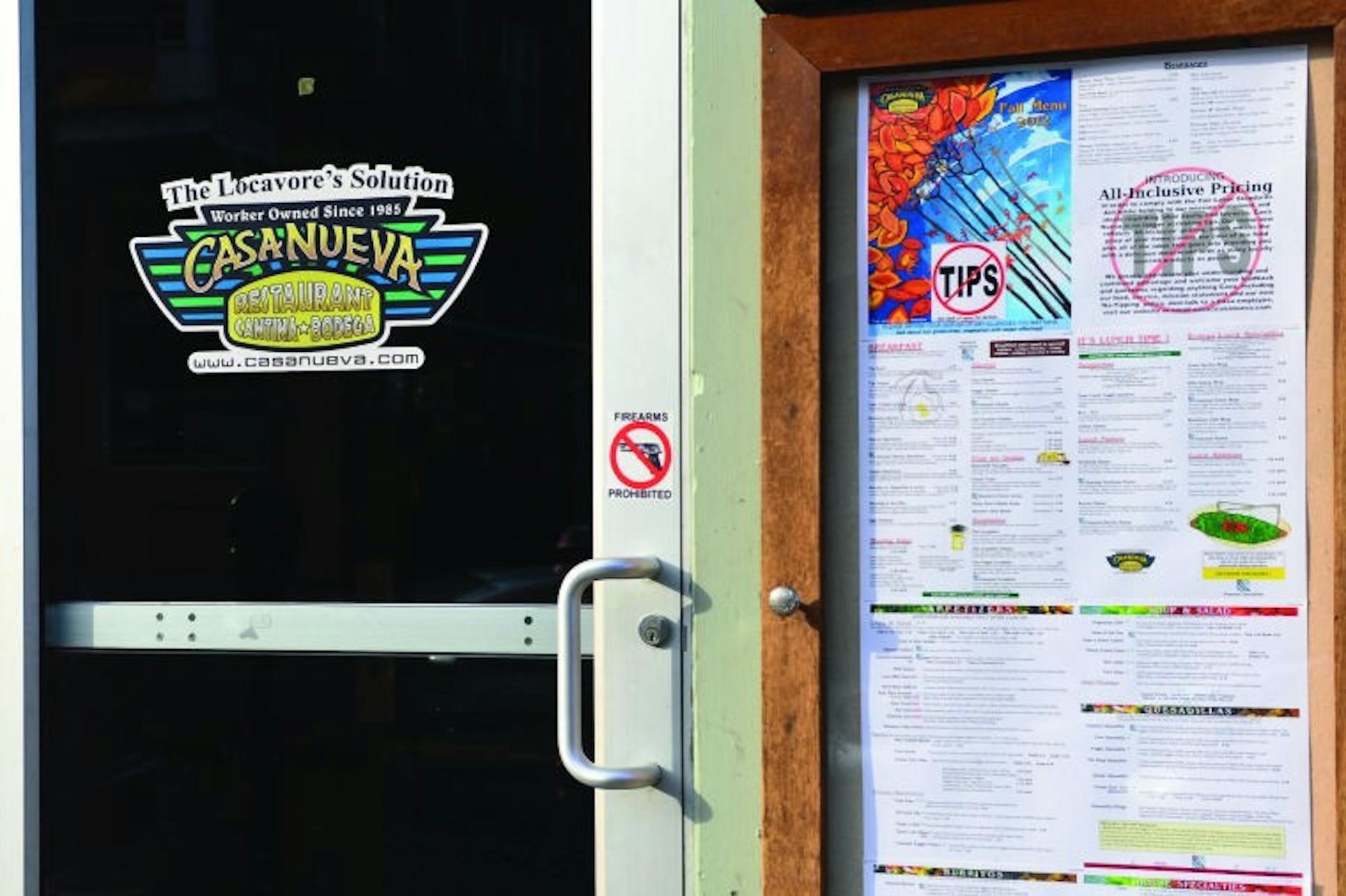
Casa Nueva has provided an alternative environment to restaurant-goers for 27 years, and now, in order to comply with new federal regulations, the restaurant will further distinguish itself by refusing to accept tips.
The new policy is in response to a change in federal law that prohibits wide-scale tip pooling at businesses, including Casa Nueva, 6 W. State St. The restaurant, which is worker-owned and has always pooled tips, will now charge more for meals to compensate for the loss of gratuity.
In 2011, lawmakers approved an amendment to the Fair Labor Standards Act, which now forbids certain kinds of tip pooling.
The law allows mandatory pooling for employees who typically receive tips while on the job, but such pools are prohibited if employees who don’t regularly receive tips are included, such as cooks, dishwashers and janitors, according to the U.S. Department of Labor.
Since its doors opened in 1985, Casa has pooled tips among the entire staff — from dishwashers to wait staff — at the end of each pay period, according to the restaurant’s website.
This system allowed all employees to work whatever task they wished on a particular day —from tending bar to preparing the food — while still making money at the same rate as all other employees, said Sherry Harvey, a worker-owner with 13 years of experience at the restaurant.
Rather than implementing a conventional tipping system that will result in some employees earning more in tips than others, Casa employees are refusing to accept tips altogether and raising their food prices by about 20 percent, effective Sept. 1, to make up the difference, Harvey said.
“We believe in equality,” said Harvey. “We want a fair system.”
In addition to equality, Casa’s workers also prefer the policy because it still gives them the ability to work whichever task they prefer, while simplifying the billing process too.
“I like the fact that everything’s inclusive; it’s a one-stop shop now,” said Casa associate Laura Young.
Some customers, however, seem skeptical of no longer being permitted to tip.
“What is your motivation to give good service?” said Steve Hill, a local resident.
A Cornell University study, cited by Casa’s website, suggests the correlation between tips and prompt service is not as strong as most would think. The employees themselves said they are surprised customers still want to spend the extra money.
“I find it funny that people are sad they can’t tip,” Harvey said, “I’m going to try to make you keep it. If we can’t get ahold of you, we’re going to donate it [the money] to a local charity like (Community Farm Initiatives).”
With Casa’s price increase, Harvey said he anticipates the restaurant will have the same income as it did before the change in law.
As it is, Athens residents and Ohio University students alike are not deterred.
“It doesn’t really make me less inclined to go,” said Chase Caswell, a junior studying environmental health and industrial hygiene.
Despite the changes, the element that keeps customers coming back will remain constant. As Hill said, “The food is still good.”
sh335311@ohiou.edu


