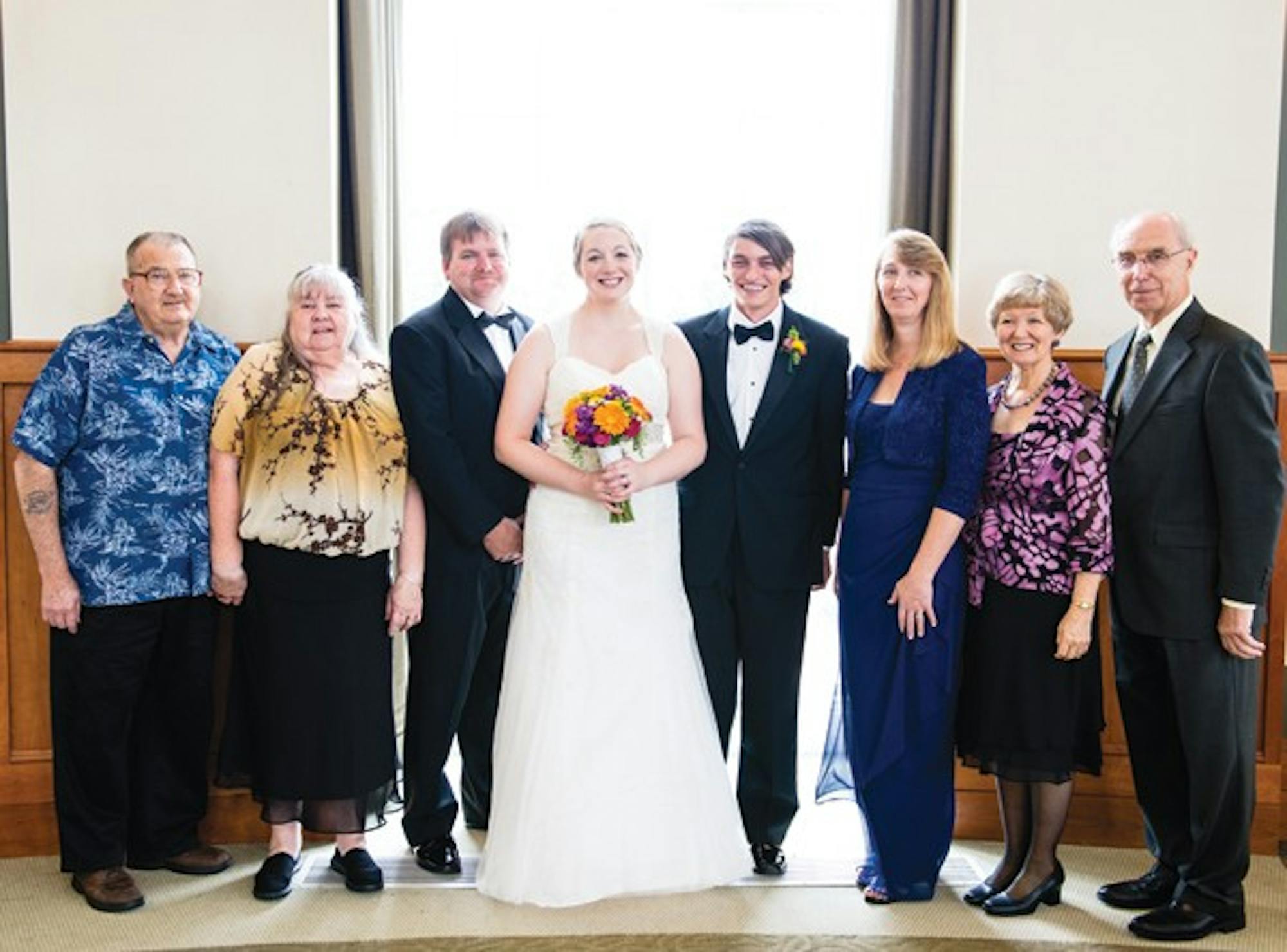
Saturday was the beginning of the rest of their lives. Wedding bells chimed, vows were exchanged and the Gleasons were announced as husband and wife.
“We wanted to spend the rest of our lives together,” said Amanda Gleason, 23, a 2012 Ohio University graduate with a degree in restaurant and hotel tourism.
And while CBS News recently reported that the number of young marriages ? in which partners are under 20 years old ? has increased by nearly 50 percent since the ’90s, these high-school sweethearts decided to wait to tie the knot until after earning college degrees.
“We wanted to be ready to have a real source of income before we started a family,” said Sean Gleason, 23, a second-year graduate student at Ohio University studying political science. “Also, to not have to worry about spending large amounts of time away from each other while married.”
The Gleasons also made this decision based on their observations of those who took the plunge at a young age.
“It is their choice to do that, and it is possible, but it might be a little harder to get everything you want out of your life,” Amanda said. “Also, one spouse’s future job or education plans might not match up with the other spouse’s job or education plans.”
And although the couple waited, the Gleasons still fall below the national average age for marriage — which is 28, according to the National Center for Education Statistics. The center also reported that 18 percent of undergraduates surveyed in 2008 are hitched.
While many might consider the Gleasons’ decision to wait a smart one, others view a rush to the altar not only an affirmation of love but also a reliever for checkbooks.
A student who is married to an Ohio resident qualifies for “instant residency,” according to the Ohio Board of Regents residency guidelines.
In other words, should a student from an outside state who is married to an Ohio resident decide to attend OU, that student would then qualify to pay in-state tuition.
For full-time OU students, this could mean knocking $4,482 off their bills each semester, according to the 2012–13 tuition schedule.
Rob Callahan, associate director for transfer initiatives at OU, said the university has no active way of tracking down students who may be getting married to save cash rather than join hearts.
“There is nothing we could request that would prove or disprove the marriage,” he said. “There is no ‘love meter.’”
Callahan added that he considers a marriage for money’s sake to be more of a hassle than it’s worth, and he doubts it has happened often.
Although the idea of marriages for the sake of slashing tuition isn’t as widespread as the more commonly known “Green Card Marriage,” websites such as whypaytuition.com are looking to take advantage of the trend. The site has attracted 56 registered users who hope to seek a match and gain in-state tuition.
“This is a marriage of convenience, not a wedding,” the site advertises. “The idea is to get married, remain married for the duration of your college years, then get a non-contested, no-property divorce. The girl will keep her last name, you live separate lives, and no one will need to know you are married.”
According to a recent report published by CNN, many marriages made to save some cash — or simply young marriages — end up falling flat. According to the 2010 State of the Union report, the average divorce or separation rate is 40–50 percent for young lovebirds.
“It’s just stupid, because you’re a college kid,” said Patrick Clark, a junior studying accounting. “But if you get married before then, at least get a pre-nup.”
The Gleasons said they are glad they waited five years to get married because now, they can focus on the future.
“We’re looking forward to beginning a new adventure together and starting a family of our own,” Amanda said.
lf328610@ohiou.edu