

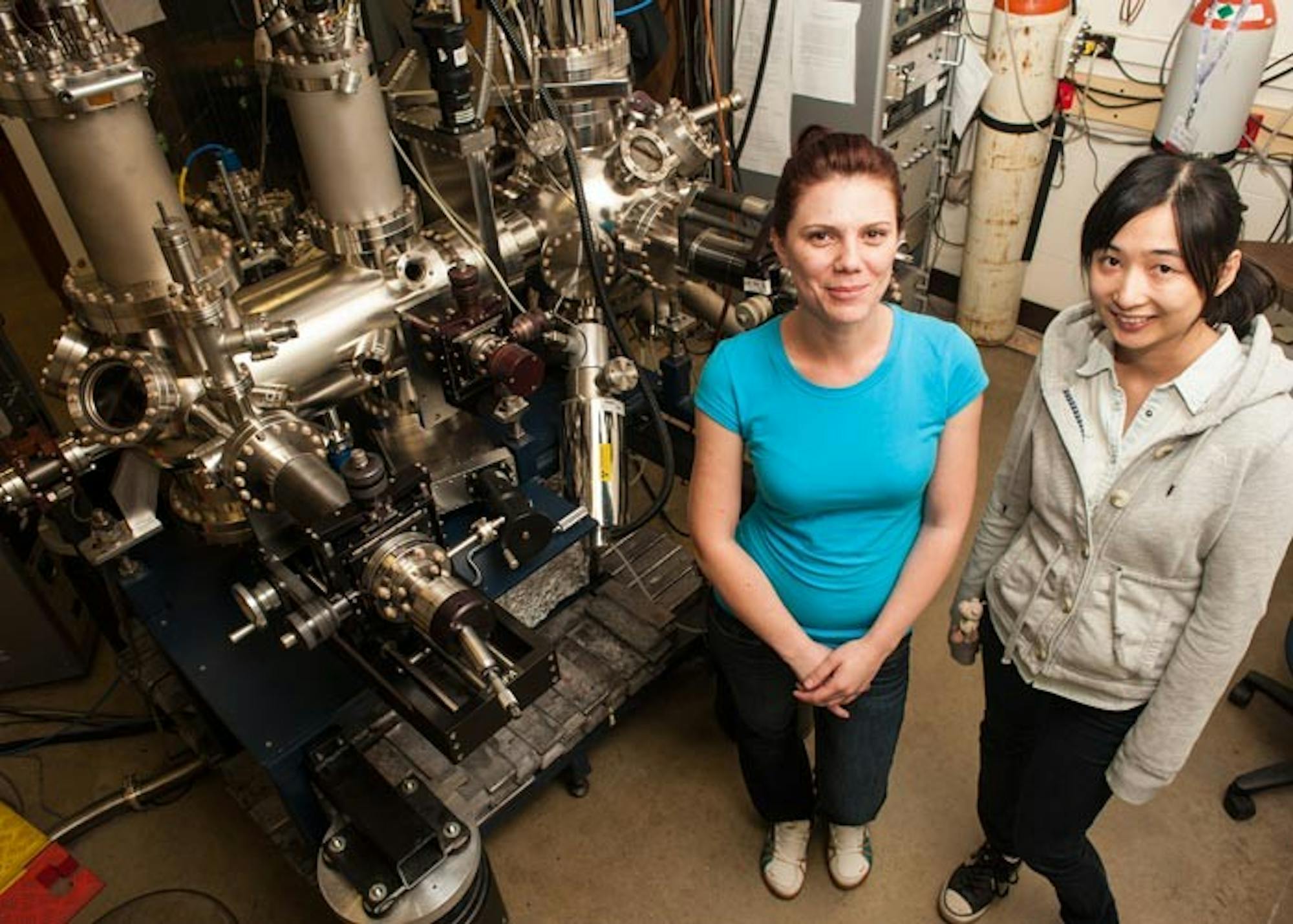
In a quest to build faster and more efficient technology for the future, a group of 26 Ohio University faculty from all different backgrounds have been looking in the smallest of places: atoms and molecules.
The Nanoscale and Quantum Phenomena Institute was founded in 2001 at OU and includes members from seven different departments.
“NQPI hopes to promote the science and study of nanotechnology,” said Alexandria Jeanneret, NQPI business manager and event coordinator. “Nanotechnology is the manipulation of matter on an atomic and molecular scale.”
Arthur Smith, director of NQPI and a physics professor at OU, said that the general mission of the institute is to advance international collaboration in nanoscience and technology and to promote student research and education in nanoscience areas.
“We have expertise in all different departments,” Smith said. “There is everything from electrical engineering and computer science to chemistry and even plant biology.”
Alan Savage, a senior studying physics, said the institute’s faculty members were welcoming and allowed him to work in the lab with them.
“It has been great working with them, especially with Professor Smith,” Savage said. “He was very open and put trust in me in working in projects, and it boosted my confidence and made me more comfortable. He has been a good mentor, and working at the institute has been a great experience.”
Jeanneret said that with such an array of backgrounds, the group members are able to “bounce” ideas off one another and write about one another’s work.
“It is very small particles, and we are dealing with one nano at a time,” Jeanneret said. “And together, we do a lot of testing on nanotechnology like spintronics, which is a form of electronics.”
The institute is mostly funded from external grants, Smith said, with most being national-level grants from federal funding agencies.
Funding from 2007 to 2011 “averaged more than $200,000 per member per year,” according to an NQPI news release. Smith said he was thrilled that the institute also won funding for a major product initiative in 2008 from the OU Graduate Education and Research Board.
“Because we are working at a smaller scale, it’s hard for people to understand implementations of our work, but we can work on drug research and synthesis of chemicals,” Jeanneret said. “Although we’re not making medical breakthroughs, we are working behind the scenes to understand things on a small scale, which will help in the long run and pay off in the future.”
bc822010@ohiou.edu


