

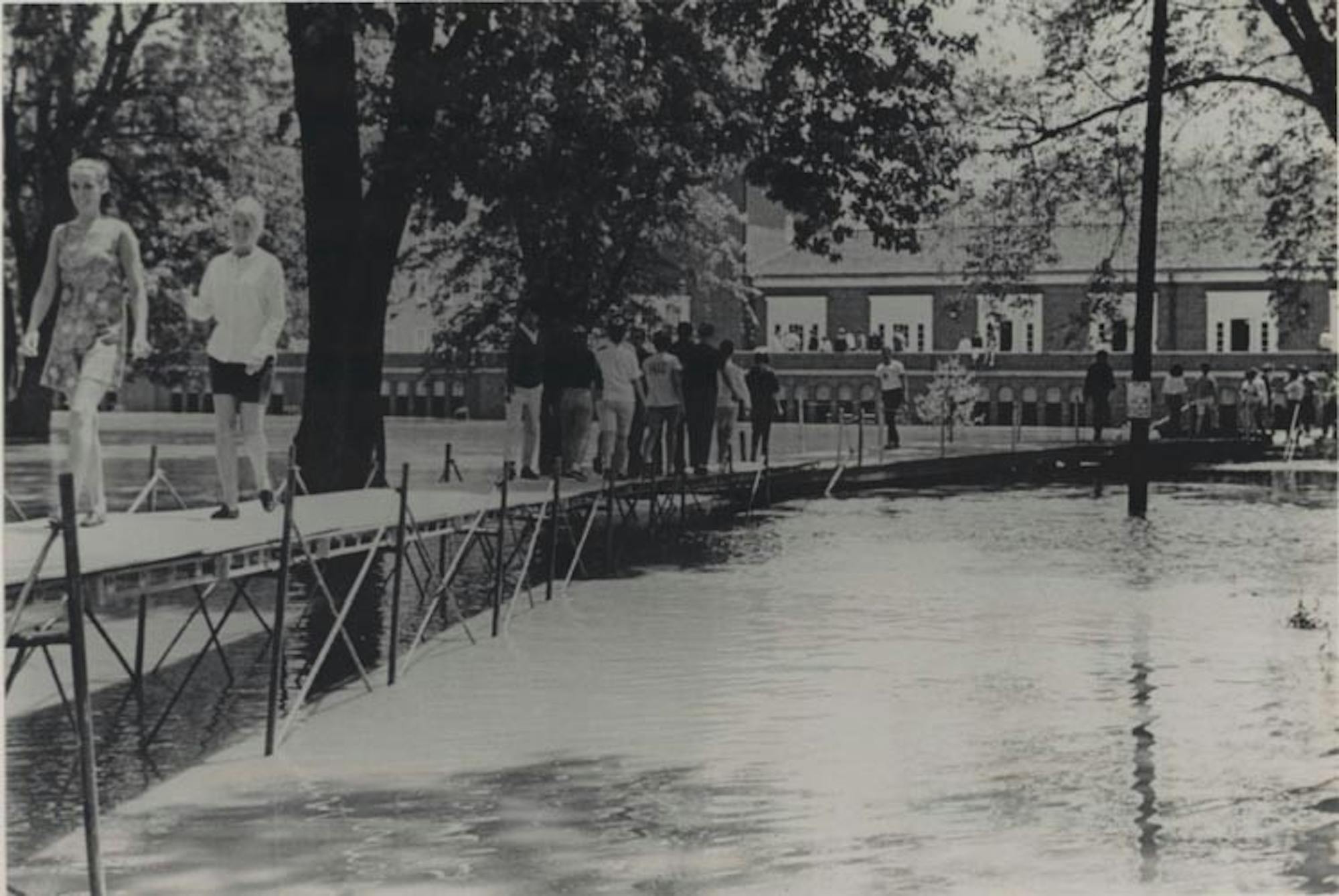
When it rains in Athens, the Hocking River doesn’t pour like it used to.
Since the reroute of the Hocking in 1969, there have been no major flooding events on Ohio University’s campus, but that does not eliminate the possibility of floods.
The Athens County Emergency Management Agency works with OU and other agencies in Athens County to prepare for and combat weather emergencies, such as the windstorms that occurred this past summer, said Dan Pfeiffer, deputy director of Athens EMA.
“During emergencies, we work with different agencies to get them the resources they need,” Pfeiffer said.
Although the risk of a flood has diminished greatly since OU’s strategic construction modifications, there is still a small risk every year of a 100-year flood, Pfeiffer said.
A 100-year flood could occur in the spring if there is significant snow during winter and rainfall in the spring, which would prevent the Hocking River from draining excess water quickly enough.
“The chances aren’t that great, because it takes a lot of rain over a long period of time,” Pfeiffer said.
Joshelyn Smith, a freshman studying vocal performance, said she doesn’t worry about possible floods on campus, even though she was aware of the major flooding that occurred in the 1960s.
“I think (the university) made enough accommodations to the campus that I don’t think (flooding) will be a problem,” Smith said.
Until the late 1960s, floods were not an emergency, but an expected nuisance.
Students could count on floods in the spring, usually at the beginning of March, according to previous Post articles in the 1960s.
However, the floods in 1963 and 1964 reached a new level of storm, according to previous Post articles.
At its peak, the Hocking River reached 24.16 ft in 1964. The river used to weave through West Green, so the flood displaced residents of Jefferson Hall and West Green dorms.
Students were evacuated to available dorms on East Green, and about 100 male residents slept on cots in the Baker Center Ballroom during the 1964 flood.
The disruptions weren’t felt only in residence halls, but also in classrooms, causing teachers to cancel tests because of power outages and constant classroom distractions, according to previous Post articles.
Physical education classes and activities were canceled because Grover Center’s floor, which used to house OU’s gymnasium, buckled and raised because of the water damage.
Despite these damages, OU was able to recover quickly, with residential living fees covering most of the damage to West Green and Jefferson Hall, even though OU had no flood insurance at the time, according to previous Post articles.
Dorm residents and fraternity and sorority members volunteered to clean up debris on campus.
To prevent future floods, OU hired the Army Corps of Engineers to design a reroute of the Hocking River in 1963.
OU also planned to evade flooding as it constructed South Green. When the layout for South Green was decided in 1967, the Residence Hall Planning Committee had incorporated an elevated walkway to connect dorms so students could avoid high water.
After all of the flood-prevention construction, the only flood that could still threaten OU students would be a 100-year flood, Pfeiffer said. He added there would be enough warning of such a flood that OU and Athens could take measures to protect students ahead of time.
In the threat of weather emergencies, EMA will warn Athens County citizens through email, text message and broadcast alerts through WOUB.
“If there’s problems going on with the weather, you need to stay alert to it and try to stay ahead of it,” Pfeiffer said.
dk123111@ohiou.edu


