

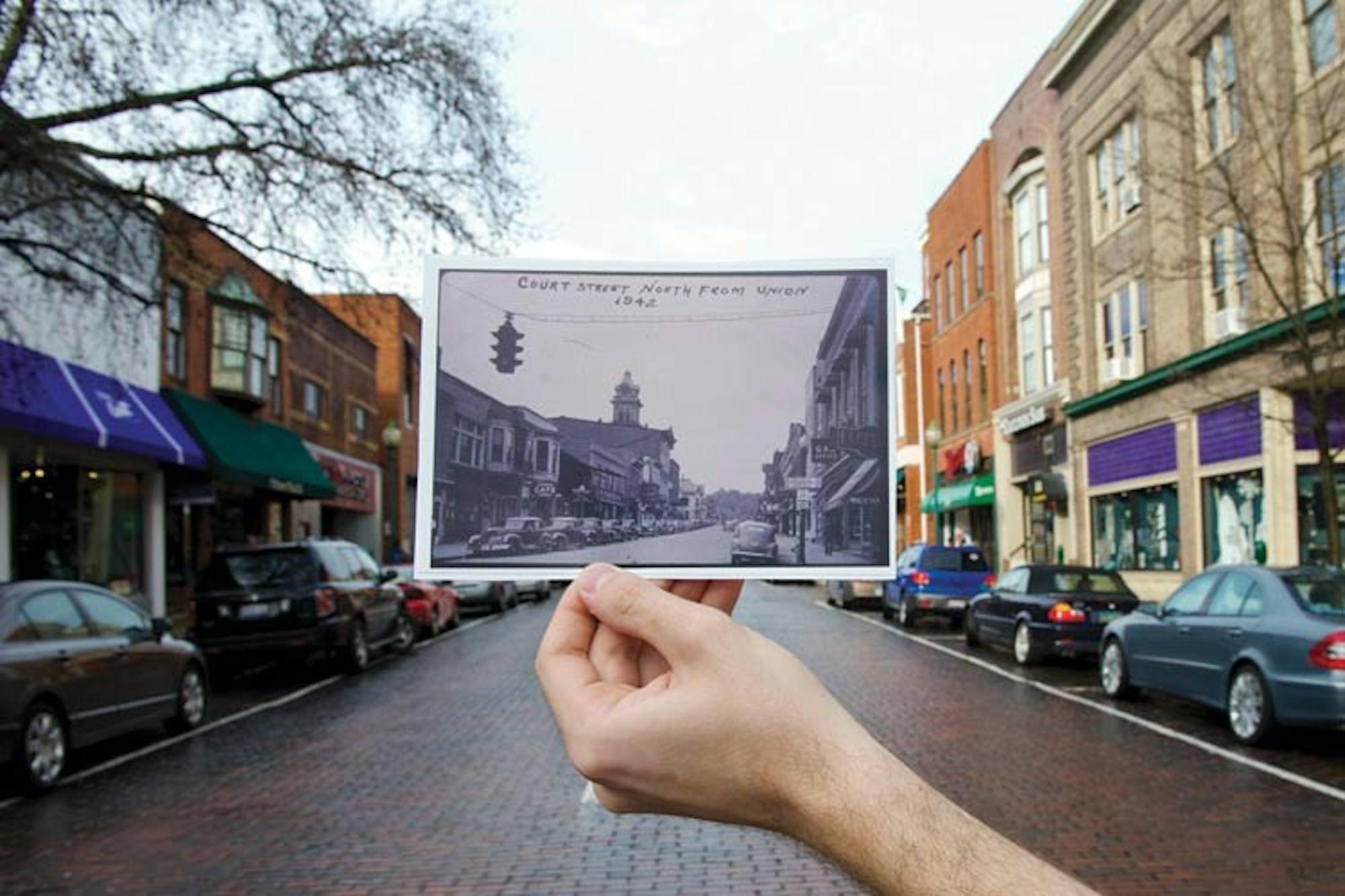
Athens’ oldest residents remember a very different city that has been transformed through the decades by students who might have unintentionally stressed town-and-gown relations.
Uptown Athens, now dominated by student-related businesses and bars, was once the commercial hub in an area dominated by local residents. As students moved in and industries left, Ohio University became the major commercial driver in Athens, which changed the economic landscape of the city and led to conflicts between residents and students.
Since he moved to Athens in 1958, former Ohio University history professor Gifford Doxsee, 88, said he has seen the city and university each evolve at its own course and has also seen them come into conflict with one another.
Housing trends have varied over time, literally bringing student influence next door, Doxsee said.
Doxsee originally lived on High Street near the Carpenter Street intersection, but student renters overran the area once he moved away in the late 1960s, he said.
“The whole character of that street changed,” Doxsee said. “It used to be a quiet and unobtrusive street. The same thing happened with Morris Avenue.”
Helen Swaim, 91, has lived in Athens, including in a residence on Morris Avenue, since the 1930s. She said she doesn’t mind the energy that OU students bring to the neighborhood.
“I’ve never had any problems (with students),” she said, adding that she used to share a backyard with student renters who were always respectful.
However, many older Athenians don’t feel the same way, said Ron Luce, director of the Athens County Historical Society & Museum.
Luce and Doxsee agreed that the increased student influence Uptown has caused animosity between lifelong Athenians and students.
In addition to residential areas, businesses have changed over time in response to student population growth, Doxsee said.
In contrast to the bars and fast food restaurants of today, most families did their shopping on Court Street 50 years ago, he said.
“Court Street was the main shopping area,” Doxsee said. “The stores were all family-oriented.”
The Uptown area was also a hub for public transportation in those days, with a bus station on Mill Street and a train station off West Union Street, Swaim said, adding that Athens was widely considered to be a “rail city” before it was ever a college town.
“Almost my whole family was (made up of) railroaders,” she said.
The B&O Railroad and various produce suppliers employed many Athenians before OU dominated employment in the 1960s, Swaim said.
When these means of transportation closed in the 1980s, the retail stores disappeared from Uptown and moved out along East State Street. Bars then filled the vacancies on Court Street as OU’s student population gradually increased, Luce said.
This conflict between town and gown existed 40 years ago, but has remained constant throughout past years, Doxsee said, adding that the war riots of 1970 were a particular boiling point.
“(At night), storekeepers were going to their stores with loaded guns and going up on the rooftops bound and determined that they were going to shoot students if any damage was done to their store,” he said.
The relationship between Athens and OU can often times be strained, but both Doxsee and Luce said more communication from each side could help solve the problem.
“There’s room for all of us,” Luce said. “It doesn’t have to be us and them.”
sh335311@ohiou.edu


