

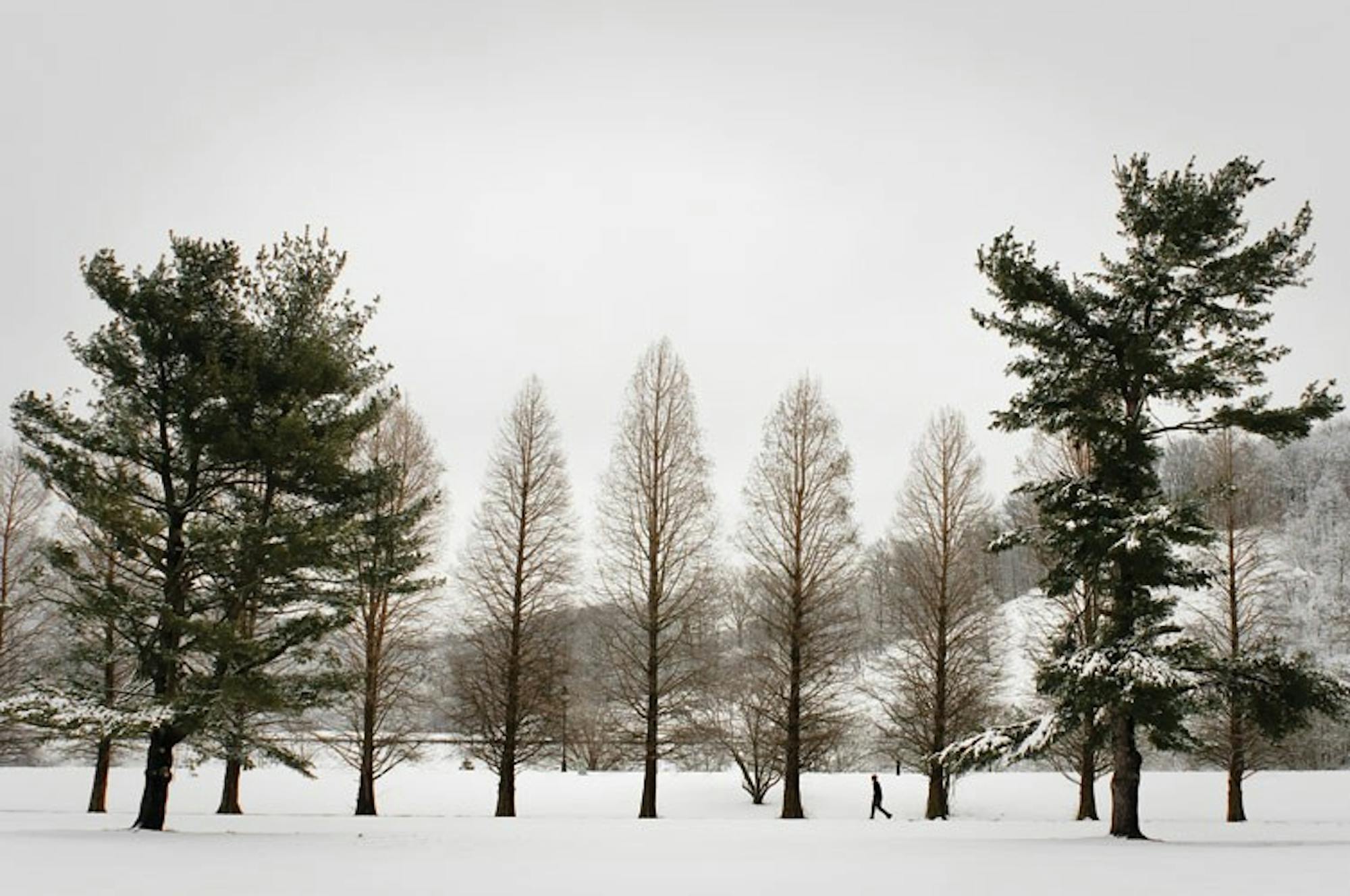
Although snow seemed to fall almost daily this past winter, the true abnormality lies within the previous winter, when Athens had its lowest recorded snowfall since at least the winter of 1969-1970.
Athens accumulated 23 inches of snow, which is on average with the period between 2006-2011. Only 4.2 inches accumulated the prior winter.
“Last year was the warmest and most atypical winter we’ve had here,” said Ryan Fogt, director of the Scalia Lab and assistant professor of meteorology at Ohio University. “And I think that on the longer record, that was one of the most unusual winters, which was the trend on a broader scale for the whole region."
The fall in temperature and rise in snowfall when comparing this winter to last winter was due to the jet stream being a lot weaker and farther south, causing more cold air from the arctic to come down, Fogt said.
“Each winter can be very different from the preceding,” said Ken Batty, a meteorologist with the National Weather Service in Charleston, W. Va. “And that’s the trend we have been noticing with winters in the Mid-Ohio Valley, both in terms of snow and temperature.”
The fluctuations are caused by changes in various parameters relating to the weather, Fogt said.
“The extent of how much snow and ice is in the arctic and northern Canada can influence how much cold air can make it down,” Fogt said. “Changes in sea surface temperatures in the Atlantic and the Gulf of Mexico can influence weather patterns as well.”
The area had more snow events than usual, but not more total accumulation, Fogt said.
“It wasn’t really weird,” Fogt said. “We had some record lows set in recent days, so it seemed to drag on a little longer. But it wasn’t glaringly bad. I think in contrast to the previous winter, which was well above normal, we seem to think it’s more severe.”
Athens Mayor Paul Wiehl said there were only a couple snowfalls that even required the city to use the plows and added that the city had adequate funding and management to accommodate for the winter.
In upcoming years, Fogt said that Athens will start to have more winters like the winter of 2012.
“Climate models predict that we will move to these warmer, drier, scenarios because the jet stream will be moving farther north,” Fogt said. “There will still be cold winters here and there, but we will see a shift in their frequency. The overall average will shift to slightly warmer, and more of them will be common such as last winter as opposed to this winter.”
as299810@ohiou.edu
(Data from the NOAA)
Snowfall by Season in inches (July-June)
70-71: 22.0
71-72: 15.9
72-73: 8.5
73-74: 4.5
74-75: 11.6
75-76: 18.5
76-77: 35.5
77-78: 54.0
78-79: 45.5
79-80: 37.0
80-81: 17.0
81-82: 39.0
82-83: 12.5
83-84: 25.0
84-85: 58.0
85-86: 37.5
86-87: 25.5
87-88: 16.5
88-89: 5.0
89-90: 18.5
90-91: 16.0
91-92: N/A
92-93 N/A
93-94 N/A
94-95: 10.3
95-96: 19.1
96-97: N/A
97-98: 2.9
98-99: 18.9
99-00: 14.9
00-01: 12.3
01-02: 4.3
02-03: 36.1
03-04: 16.8
04-05: 15.7
05-06: 7.1
06-07: 15.5
07-08: 22.7
08-09: 16.1
09-10: 30.1
10-11: 24.3
11-12: 4.2
12-13: 23.0


