

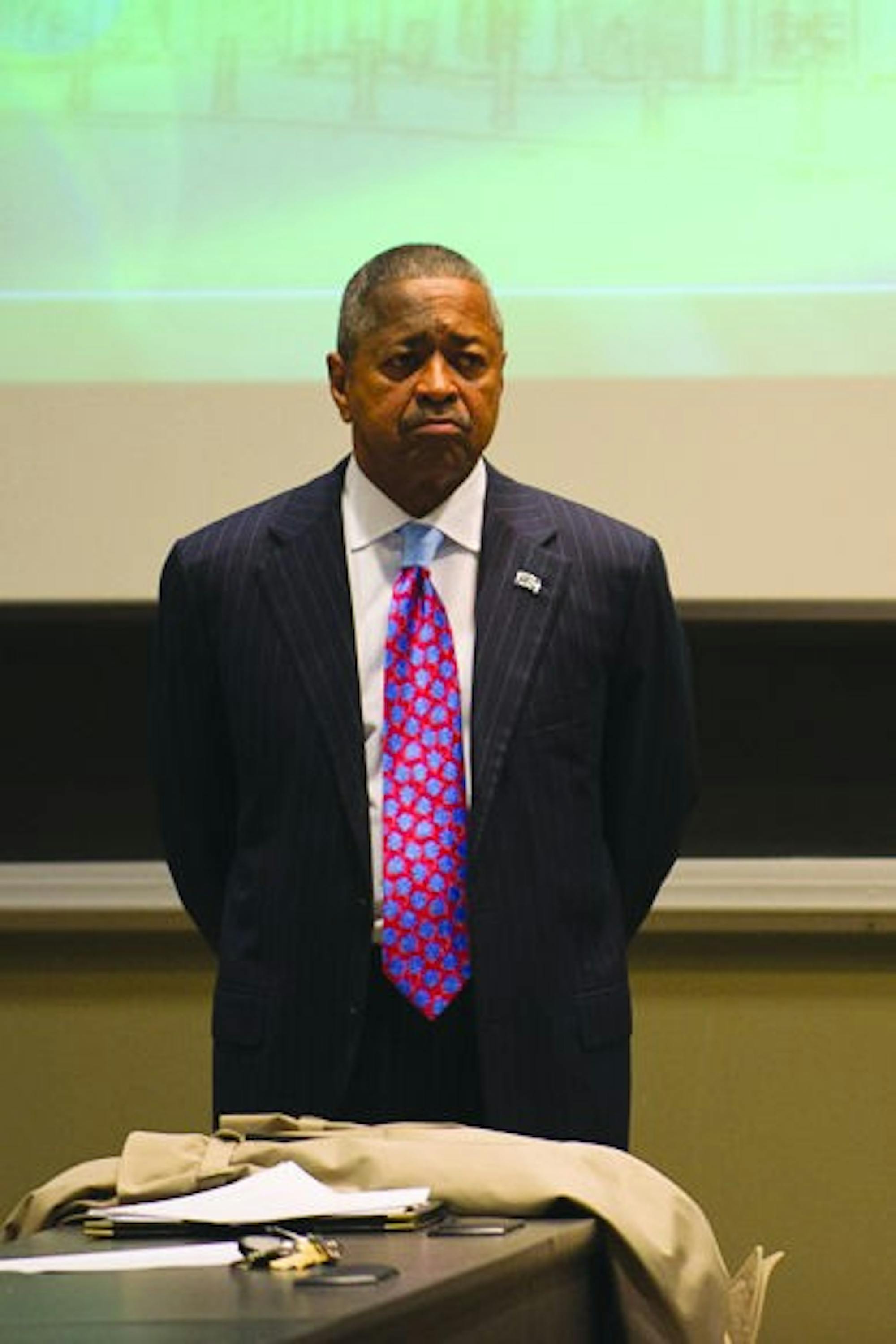
Ohio University administrators visited Faculty Senate to update the body on what was discussed at last week’s Board of Trustees meeting.
OU President Roderick McDavis began the meeting by notifying senators that OU submitted its state funding requests to the Ohio Higher Education Funding Commission 2.0 — which he leads — Friday following the Board of Trustees meeting.
OU is requesting funding for its deferred maintenance projects. McDavis said he hopes the state’s funding pool this time around will be comparable to the money OU received as part of the last Higher Education Funding Commission’s recommendations, approved in the 2013-14 state budget.
“I am very optimistic that this process will take us where we want to go,” McDavis said.
McDavis also highlighted OU’s current rank among Ohio public universities as the institution with the highest increase in enrollment, the No. 1 ranking in Senate Bill 6 composite score and the largest projected increase in State Share of Instruction.
“The fact that we came out No. 1 in State Share of Instruction is very much due to you and your colleagues and their work,” McDavis said.
Senators expressed concerns about how increased recruitment and retention impacts the diversity and preparedness of the freshman class.
Executive Vice President and Provost Pam Benoit responded by explaining how OU’s current recruiting strategy is to target high school students in their freshman or sophomore years, while David Descutner, dean of University College, reminded senators of the Allen Student Help Center to address incoming students’ problems.
“We’ve held true to the accessibility and excellence missions,” Descutner said.
In order for the university to maintain its high rankings, Benoit announced OU’s commitment to the Academic Quality Improvement Program path for accreditation, which it began in 2002.
Now that OU has submitted its 125-page system portfolio to the Higher Learning Commission, the organization that will evaluate OU’s reaccreditation, the provost’s office will continue to prepare faculty, students and staff to answer questions should they be called on during the reaccreditation process.
“I think our first step — the system portfolio — looks very strong,” Benoit said. “We have a great institution that we cannot let down.”
Elizabeth Sayrs, chair of Faculty Senate, asked Ryan Lombardi, vice president for Student Affairs, and Susanne Dietzel, director of the Women’s Center, to discuss the results of the Campus Conversation held Oct. 24 regarding sexual assault and bystander awareness.
Lombardi and Dietzel said they hope to continue these conversations; the next Campus Conversation will be held Nov. 18 from 10 a.m. to 2 p.m. in Baker Ballroom.
“What really became apparent to us is that we need more training on bystander intervention,” Dietzel said.
John Day, associate provost for academic budget and planning, gave a brief presentation on Resource-Centered Management to explain how individual college deans will budget their curricula between fiscal years 2013 and 2017 — when RCM will be up for its five year evaluation.
Undergraduate credit hours will be weighted based on their statewide costs, similar to the differential tuition model on which OU currently operates, Day said.
Faculty Senate ended the meeting with discussion of the next academic calendar.
The provost’s office worked with Athens City Schools to align the public schools’ spring break with OU’s, beginning March 2, 2015, Benoit said.
In addition, following last spring’s discussion of the quarter to semester transition, Sayrs said she is currently discussing the possibility of a fall break in October with the provost.
Faculty Senate will vote on a resolution to remove its requirement of convening the second Monday of every month at its Dec. 9 meeting.
dk123111@ohiou.edu
@DanielleRoss84


