

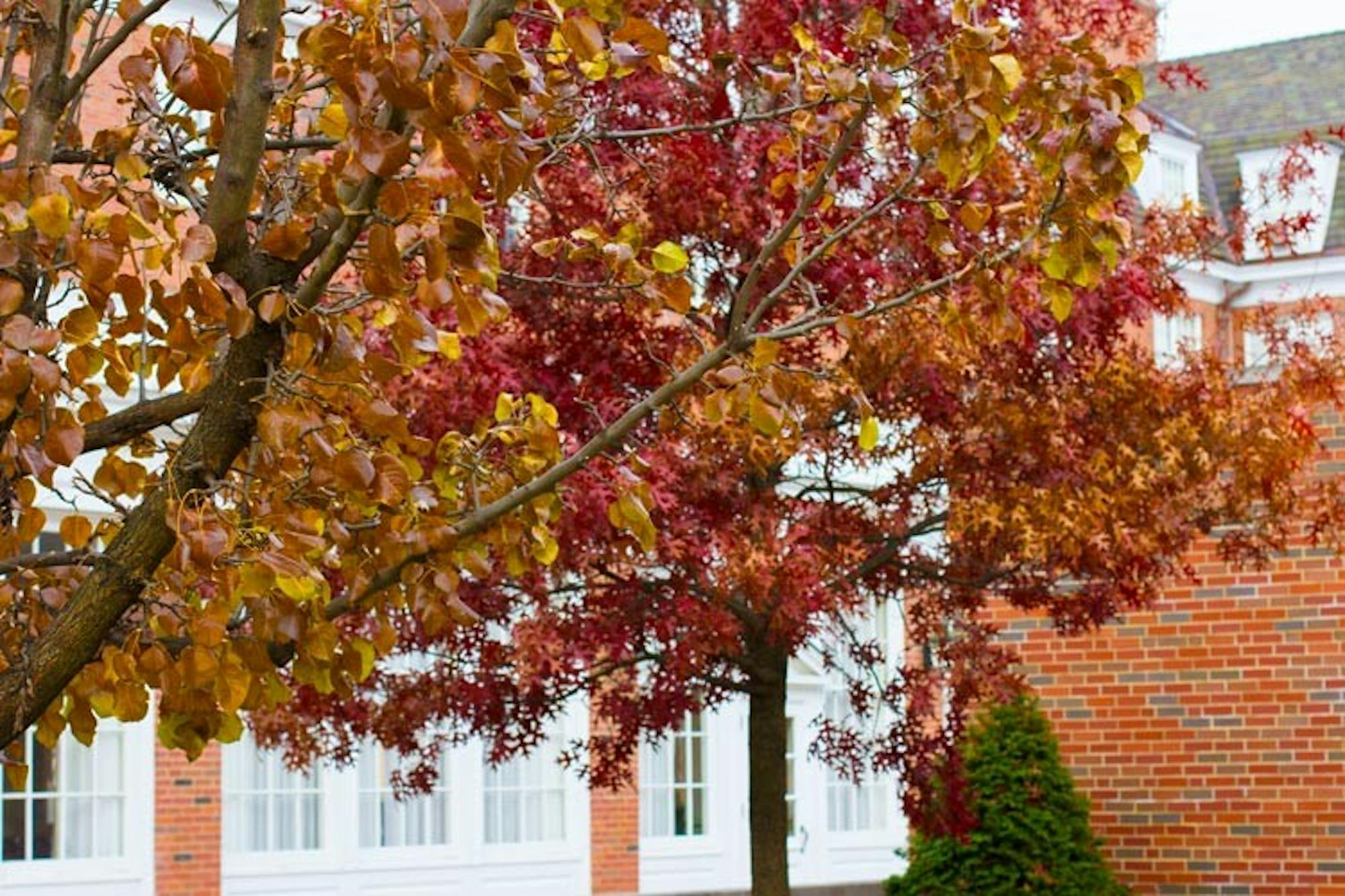
Ohio University and the city of Athens don’t waste time in clearing the streets of leaves.
The university spends between $100,000 and $150,000 on labor, collecting and processing leaves while the city of Athens spends about $32,000 a year to keep the streets leaf-free, with about $25,000 going toward labor costs, according to university and city officials.
The university’s numbers were not exact because funding for leaf removal is part of a larger budget, said Steve Mack, director of Facilities Management.
“It’s a service to the community,” said Andy Stone, the city’s engineer and director of public works. “At the same time it’s also beneficial to the city. It keeps leaves from gathering in the sewers … and clogging storm drains.”
The city is sectioned off into three zones, which are tended to four times each from October to December. The final sweep of all neighborhoods will be from Dec. 16 to Dec. 20.
A map of the leaf collection zones can be found on the city’s website.
Besides general collections, residents of Athens also have the choice to have leaves from their property picked up with the purchase of a city yard-waste sticker for $1.50, which must be placed on trash bags for collection, according to the city’s website.
Ohio University’s grounds department is in charge of leaf pickup and disposal on campus, which it does two to three times a week in autumn and winter months, depending on need, Mack said.
“(Leaf collection) varies depending on what kind of year you have,” Mack said.
In a typical year, about 350 to 400 cubic yards of leaf material are collected on campus, though the leaves are heavily compacted, while about 1,000 cubic yards are collected from the city.
A cubic yard is a three-dimensional cube that measures one yard on all sides.
Both the university and the city recycle the leaves and use them as compost and mulch. Massive vacuums suck the leaves off streets and sidewalks of both the city and university.
The city takes leaves either to nearby farms or community gardens, where they are laid out and naturally composted. The university transfers materials to its Class IV Composter located at The Ridges.
The composter turns leaves and other materials into mulch, which is then distributed throughout campus, according to a previous Post article.
“(Creating mulch) has enormous cost savings. Why buy a product when we already have it?” said Glenn Matlack, an associate professor of environmental and plant biology. “If we burn it, it becomes a greenhouse gas. If we compost it … it disappears magically.”
db794812@ohiou.edu
@Dinaivey


