

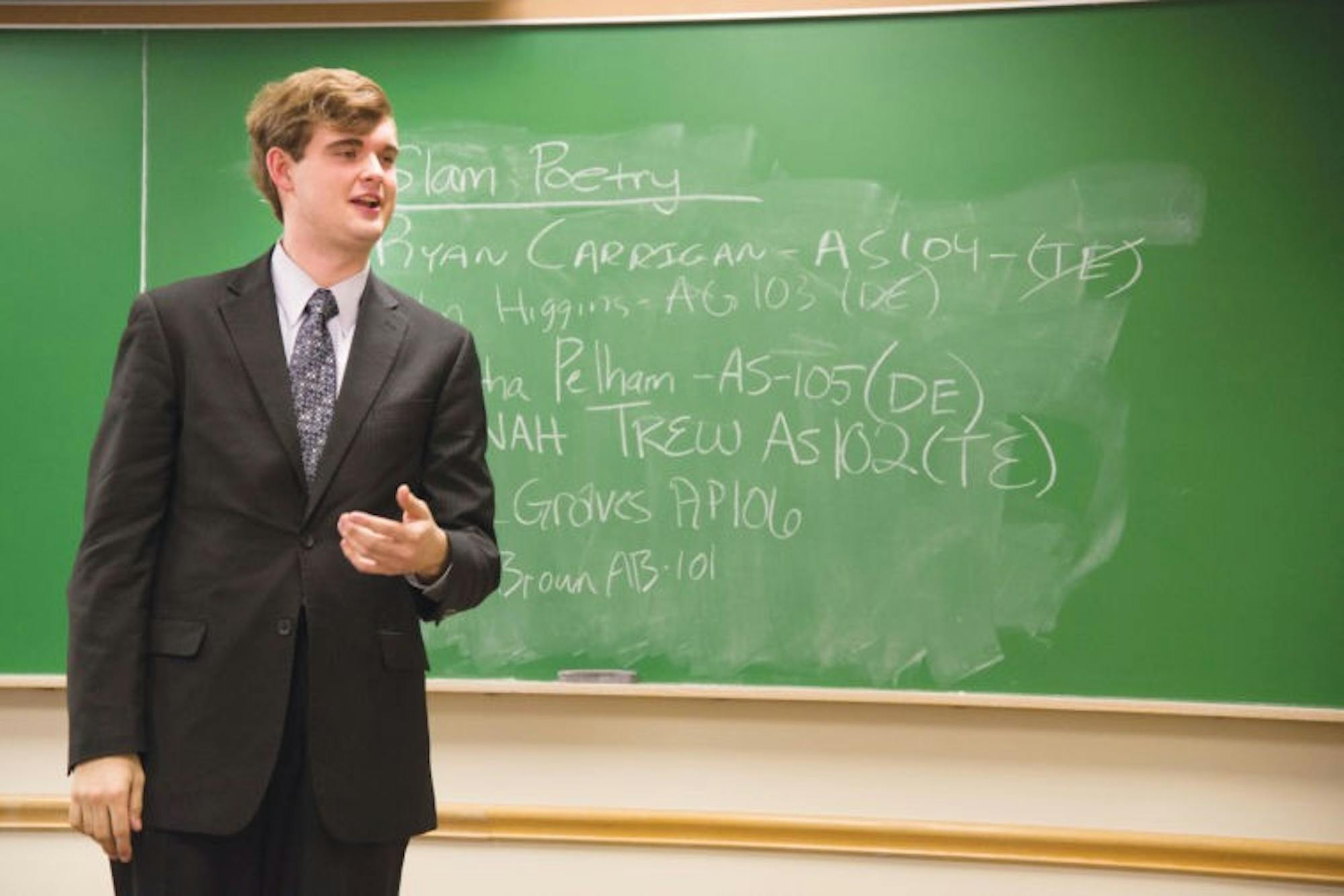
A Speaking Bobcat could spend multiple hours preparing for just one debate that could take only minutes to perform.
Ohio University’s speech and debate team competes almost every weekend, typically at the regional level, to prepare for the extremely competitive and annual national event.
Dan West, OU’s John A. Cassese director of forensics, has trained 40 national champion speakers since he began coaching at OU in 2005.
Now, West hopes to make changes to the national competition, hosted by the National Forensics Association, that could travel far beyond his six-person team.
The association oversees all college speech and debate competitions across the country. It puts on 10 events for debate team categories, such as public address events and limited preparation events.
West hopes to add new categories — public communication events — that relate to more careers, such as a PowerPoint sales pitch or a theater audition monologue.
OU held a regional speech tournament Saturday and offered some of the new events, including Radio Broadcasting.
Other teams, such as Berea College in Berea, Ky. and Butler University in Indianapolis, are starting to take interest in these events, but West said he hopes to see more students studying subjects outside of communication take part in speech and debate.
“The more students on this campus (who) take practice of communication outside of the classroom, the better they’ll do in the workplace,” West said.
OU will host two national speech and debate tournaments in 2015, where West hopes more students compete in the new events.
Nationals at OU are unique in that the community is involved. Such an event attracted about $857,000 to area businesses in 2012, when OU last hosted.
The six team-members, along with various faculty and graduate student coaches, spend at least six to eight hours a week practicing for the multiple events in which they hope to qualify for at the national level.
“We realized in semesters we were asking a lot from students,” West said. “It’s not to weed people out; it’s to recruit those who can.”
The team would like to have more students, but the demanding schedule deters some, West said.
Schedules for competitions require a lot of time. Students and coaches might travel on a Friday night, compete all day Saturday only to leave later that night to finish homework and have some free time, West said.
The team receives a little more than $84,000 from OU as a budget for traveling to and hosting competitions, which covers most costs, West said.
OU’s pace isn’t as intensive as other competing schools, said Justin Rudnick, a second year doctoral student in communication studies and associate director of forensics.
“They still have half a weekend to get their work done, so that way we aren’t taking them away from school,” Rudnick said.
Ryan Carrigan, a sophomore studying political science in his second year on the Speaking Bobcats, is working on seven events this semester, and he said he hopes to qualify for Nationals in at least five of the events.
For every event at a speech tournament, competitors deliver a memorized speech, lasting up to ten minutes depending on the event, in front of two judges — which they then must repeat or improve in two or three rounds.
For a competitor like Carrigan who enters up to five events, that means he could potentially deliver 15 speeches in one day.
Judges then rank competitors out of 100 points, and the top six students in each round take home an award.
Currently, Carrigan qualifies for the national competition in three events — extemporaneous speaking, impromptu speaking and informative speaking.
“I won’t deny that it is difficult and that it has created problems in the past, but it’s just a question of time management,” Carrigan said.
@DanielleRose84
dk123111@ohiou.edu
Speech Team Events
Persuasion: Competitors give a speech to convince or move to action on an issue.
Extemporaneous: Competitors choose one of three topics offered by the judge and have 30 minutes to create a speech on the subject.
Impromptu: Competitors have 10 minutes to prepare and deliver a speech based on a short excerpt or quote.
Rhetorical Criticism: Competitors provide a critical analysis of a significant piece of rhetoric.
Informative: Competitors provide a factual speech on a topic.
After Dinner: Competitors deliver a lighthearted and sometimes humorous speech on a social issue.
Prose: Competitors memorize and perform a section from a piece of literature.
Poetry: Competitors memorize and perform a poem.
Dramatic Duo: Two competitors perform a dramatic scene, which can be serious or humorous.
Dramatic Interpretation: A competitor performs a piece of dramatic literature, which can either be humorous or serious.
This article appeared in print under the headline "OU’s speech and debate team is preparing for national competition with a large time commitment to practice."


