

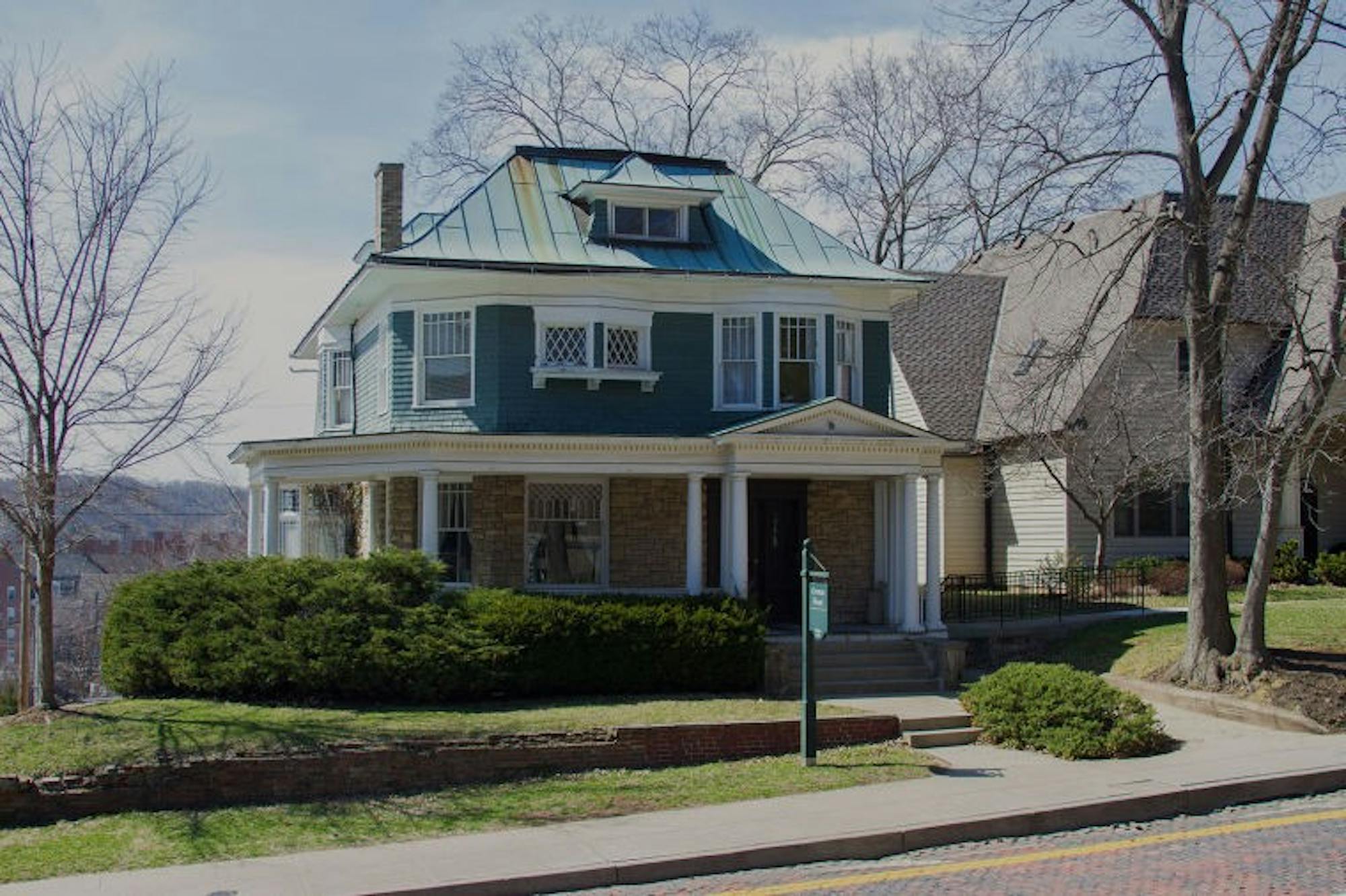
While Ohio University students and faculty shuffle in and out of Baker University Center everyday, just across the street, the Office for Institutional Equity is fielding complaints relating to sexual misconduct, disability and other topics.
The office, located in Crewson House at the corner of Court Street and Park Place, deals with student, faculty and staff-related civil rights issues.
“Every campus around the country is responsible to have a place where people can go (to learn about) policies under the civil rights legislation,” said Dianne Bouvier, interim executive director of the Office for Institutional Equity.
The house, built in 1920, used to be home to the Chubb family. Upon entrance today, the building still has a homey feel — potted plants, pictures, a wooden staircase and stain glass windows are dotted throughout the house.
Some of the office’s policies are based off federal and state laws, such as maintaining equal opportunities and complying with the Americans with Disabilities Act.
The office acts as an impartial investigatory body, Bouvier said, unlike other university offices such as the ombudsperson, which typically advocates for one side of the argument.
“Right now we’re working with (the Presidential Advisory Council on Disabilities and Accessibility Planning) members and departments on campus to have disability thought about on every aspect of campus,” Bouvier said.
Office for Institutional Equity representatives are in contact with nearly every office and department at OU because of the nature of their work, Bouvier said.
For example, OIE developed a required, online training session on discrimination and harassment policies for all OU employees who are in a supervisory role. In March, more than 850 employees completed the training.
The office partners with the Office of Community Standards and Student Responsibility to investigate cases of sexual misconduct, such as the alleged Court Street rape, said Martha Compton, community standards director.
“We handle all complaints under the sexual misconduct policy that involves students as perpetrators together,” Compton said. “It’s a joint investigation. We interview the student together; we go through the entire process as a team of investigators.”
Student-to-student sexual misconduct cases by far make up the greatest number of “intakes” — or cases brought to their attention — regardless of whether it’s investigated further, Bouvier said.
That number, for students, faculty and staff, was 44 in the 2012-13 fiscal year.
The total number of intakes was nearly 90 in that same fiscal year, reflecting a trend where, for the past three years, that number has decreased.
In the 2009-10 fiscal year, the office received nearly 150 intakes.
“In general, we’re in a better place than we were 10 years ago,” said interim Chief of Staff Laura Myers, who was the Office for Institutional Equity executive director until last year. “I think there are ... a lot of positive proactive efforts on campus that partially explain (the decline).”
Among the efforts are programs related to sexual misconduct and consent by entities such as the Women’s Center, LGBT Center and groups like F--ckRapeCulture.
“It’s hard to step forward and to say ‘Something is wrong,’ and ‘I’d like to do something about it,’” Bouvier said. “I feel like all of us here are really motivated by wanting OU to be a better place.”
DB794812@ohiou.edu
@DINAIVEY


