

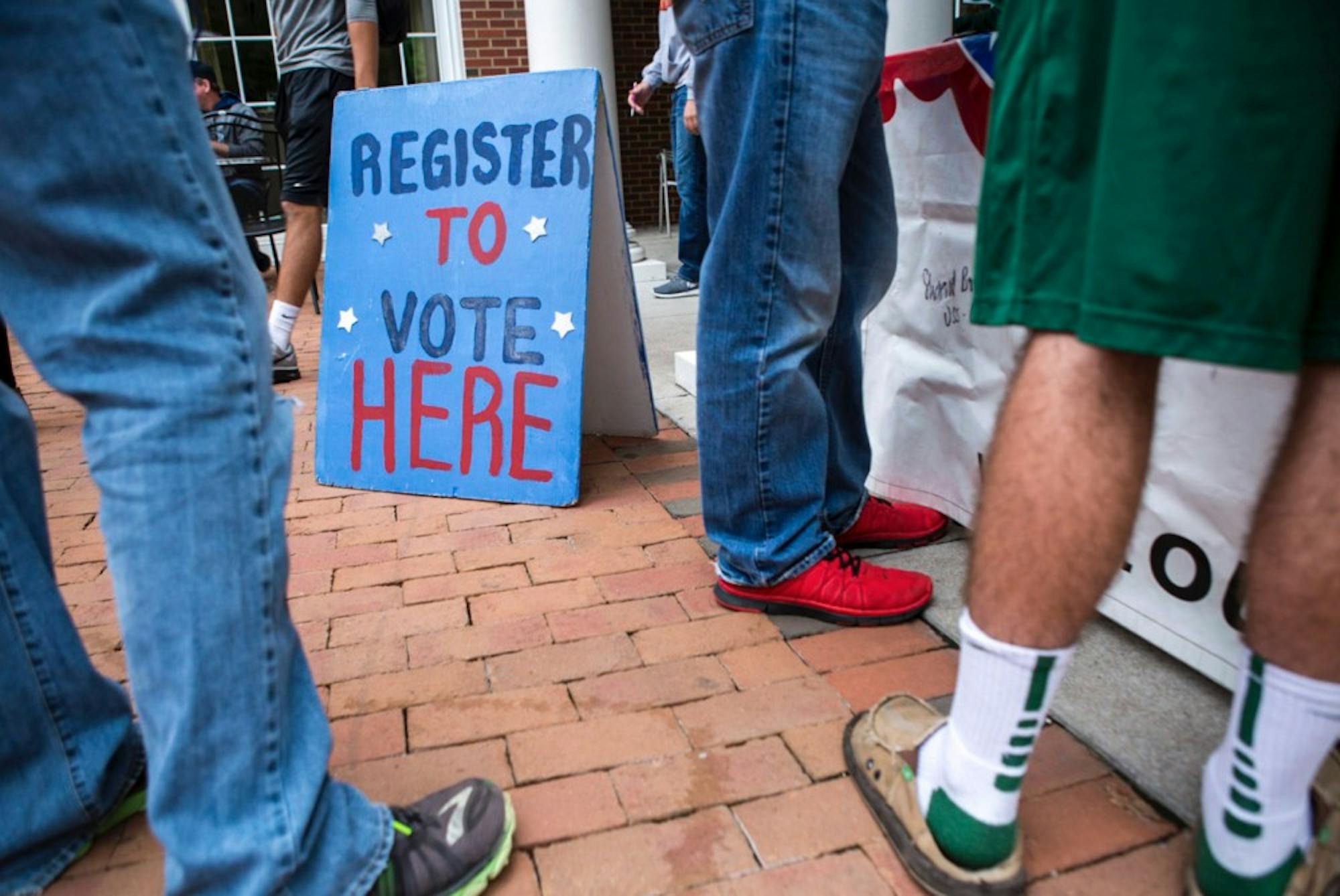
Though trends show young people go to the polls less than any other age group, students at Ohio University and on campuses across the state are working to change that.
During previous elections, college-aged voters have been less likely to cast a vote than their grandparents, parents and even their older siblings, according to data from the U.S. Census Bureau.
Athens has been no exception to that trend. During the last presidential election in 2012, about 28,000 of the city’s roughly 47,900 registered voters went to the polls. Of those votes, 5,121 were cast at Baker Center, which was the primary polling place for those living in residence halls in 2012, according to data from the Athens County Board of Elections.
There are more than 8,000 students living on-campus, and more than 17,500 total undergraduate students attending the Athens campus, according to OU's Office of Institutional Research’s University Profile.
Nationally, people between the ages of 18 and 24 are about 30 percent less likely to head to the polls than voters older than 65. The average youth turnout during the past three elections in Ohio was about 53 percent, which is slightly higher than the national average, according to data from the U.S. Census Bureau.
Some political experts say the downward trend for the turnout for young voters may be due to a lack of attachment to their college or hometown communities. Additionally, some young people carry the mindset that students' votes won’t change the outcome of an election, according to a report from USA Today.
Several groups on OU's campus and campuses across the state are working to improve the voter turnout rate among college students by educating and registering them by the Oct. 11 deadline. The Athens County Board of Elections on Court Street also has voter registration forms available.
According to the Board of Elections, there are currently about 41,500 people registered to vote in Athens, though that number will change. Board Director Debbie Quivey said they expect a large turnout this year, especially from students.
The board held a voter’s drive and had nearly 2,000 registration forms brought in during that time.
“Every presidential election every four years, the students vote,” Quivey said. “We can tell by looking at them, the addresses and things. We know that the biggest group we get through here are students.”
OU College Republicans President David Parkhill, a junior studying business management and strategic leadership, said his group does not approach students on campus to register them, as Athens tends to fall to the left on the political spectrum. Instead, he primarily focuses on registering students he knows are Republicans — those that attend the College Republicans' weekly meetings.
Still, Parkhill said it is just as important for people who do not share his beliefs to get involved and vote.
“I want students to realize this is probably one of the most important elections,” he said. “I know we are all 20 years old, but this election is extremely important to our futures.”
Sam Miller, OU College Democrats president and a junior studying journalism, said the College Democrats set up a table on campus twice a week and walk around each night in order to register as many students as possible.
“When we register students, we let them know this election is very important for our state and country, and that Ohio has a huge part to play in that,” she said.
Student groups at other universities, such as Kent State University and Bowling Green State University, are trying to increase the number of young voters at the polls as well. According the Ohio Department of Health's Network of Care database, all three universities were located in counties with less than 25 percent voter turnout in 2012, which fell far lower than the national average for the year.
To combat that low turnout rate, both Kent and Bowling Green have voter registration forms available on campus. Much like OU, politically involved students are not taking a back seat in getting their peers to the polls.
“It’s definitely not easy, but we need students to do it,” Hana Barkowitz, the president of Kent State University College Democrats, said. “It’s so important because it’s hard to tell students their vote matters just as much as anyone else’s. This is our future, even more so than the older people who are voting because we are younger.”
Parkhill and Miller both said the two major party candidates — Republican Donald Trump and Democrat Hillary Clinton — have the potential to influence the country’s future, and the results of the election could impact the lives of young voters for longer than just the next four years.
“Voting is always important, but this year it is more crucial than ever,” Miller said. “We have the opportunity to change the course of history, regardless of which candidate you support.”


