

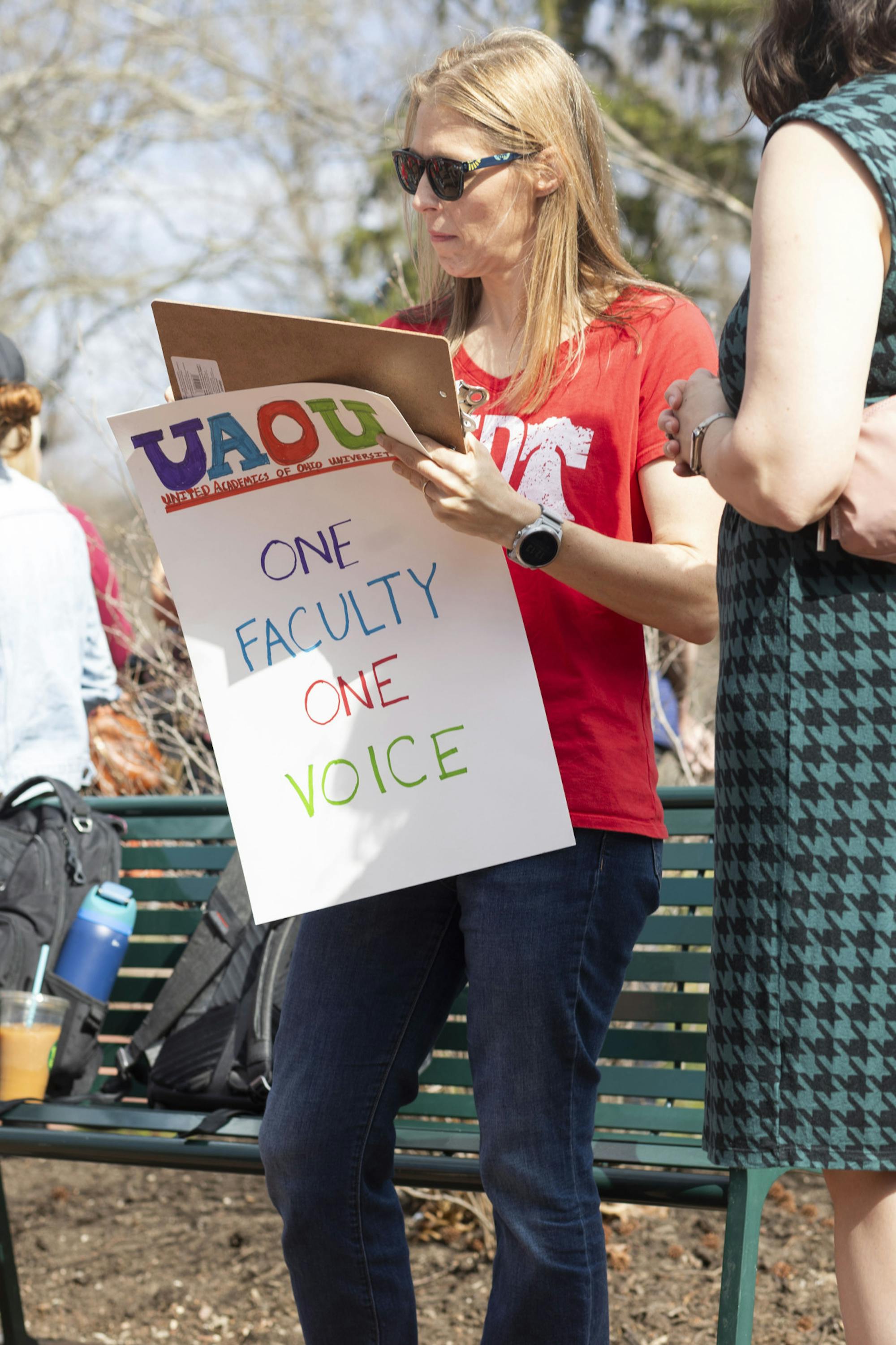
The United Academics of Ohio University took to College Green on Wednesday, where speakers updated faculty, staff and students on the ongoing bargaining process with university administration.
Nearly 18 months after filing to unionize, and six months after a vote, UAOU has begun official contract negotiations with the administration.
Following a 453-189 vote in favor of unionization March 24, UAOU appointed a 10-member bargaining team to represent faculty at the table, according to a previous report by The Post.
Mary Kate Hurley, associate professor of English, opened the rally by outlining the union’s progress so far.
“We are currently in the bargaining process,” Hurley said. “Our team has met with the university lawyers four times so far. It would have been six meetings, but the administration did cancel two of those sessions.”
Despite setbacks and cancellations, Hurley said the bargaining team has still made progress.
“We have proposed 13 articles for their consideration. So far, the administration has responded to two of them, and we look forward to seeing more of their counter-proposals, hopefully soon,” Hurley said.
Currently, UAOU’s bargaining team is drafting a financial proposal aimed at ensuring the university can continue providing high-quality education to all students.
Sarah Webb, associate professor of instruction in the Department of Social Work, said she hopes to see continued momentum in the coming weeks.
“We’ve shown up several times with our proposals with no response back, so to hear that we’re making progress is really exciting and hopeful,” Webb said.
Hurley added that although the administration has canceled sessions, caused delays and been slow to respond, UAOU remains committed.
“When the administration meets our representatives for bargaining, they need to know that the faculty are not just represented by our team,“ Hurley said. "We stand behind them. We’re paying attention, and we’re ready to show up to support a strong contract.”
Webb also emphasized the importance of securing a contract that improves both working and learning conditions.
“All of our faculty love this university and their students,“ Webb said. "The sooner we get a contract, the better conditions we will have for faculty and for students.”
Amy Roberts Leyshon, assistant professor of instruction in the social work department, said she hopes to see the first faculty contract in OU history secured during her time at the university.
She also pointed out pay disparities between OU faculty and those at peer institutions.
“I won’t lie. I was surprised to learn the salary range for my role here at OU,“ Leyshon said. "Having applied to similar roles in other institutions, I’m aware of the going rate for this work.”
According to a previous report by The Post, OU ranked second among public universities in average salary for the 1994-95 academic year. By 2017-18, the university had dropped to eighth.
Matt Felton-Koestler, an associate professor, said he wishes the administration would prioritize faculty, staff and students rather than delay negotiations.
“The faculty I know are passionate about teaching and invested in high-quality research, so I can’t understand why the administration puts up roadblock after roadblock,” Felton-Koestler said.
He added the lack of support forces faculty and staff to focus on pay and contracts instead of their work.
Tylar Ayers, a senior studying political science and a representative of the Ohio Student Association, said OSA has worked closely with teacher unions like UAOU.
“We’re seeing that if the school is willing to bulldoze their teachers, there’s no telling what they’re willing to do to students, and we’re really just seeing that it’s disappointing and frustrating how (the Advance Ohio Higher Education Act) really has shaken up the entire university,” Ayers said.
Ayers said she hopes the university listens and ensures UAOU’s success in negotiations, noting that student interests are tied directly to faculty working conditions.
“It affects everybody, even if you don’t necessarily feel the effects of it,” Ayers said. “People are making decisions about your education. You’re not being consulted on them, so you should care about that.”


